
What Savings Timeline Can You Expect When Moving Manufacturing to a New Asian Country?
What savings timeline can you expect when moving manufacturing? Discover realistic timelines and strategic planning. Learn how.
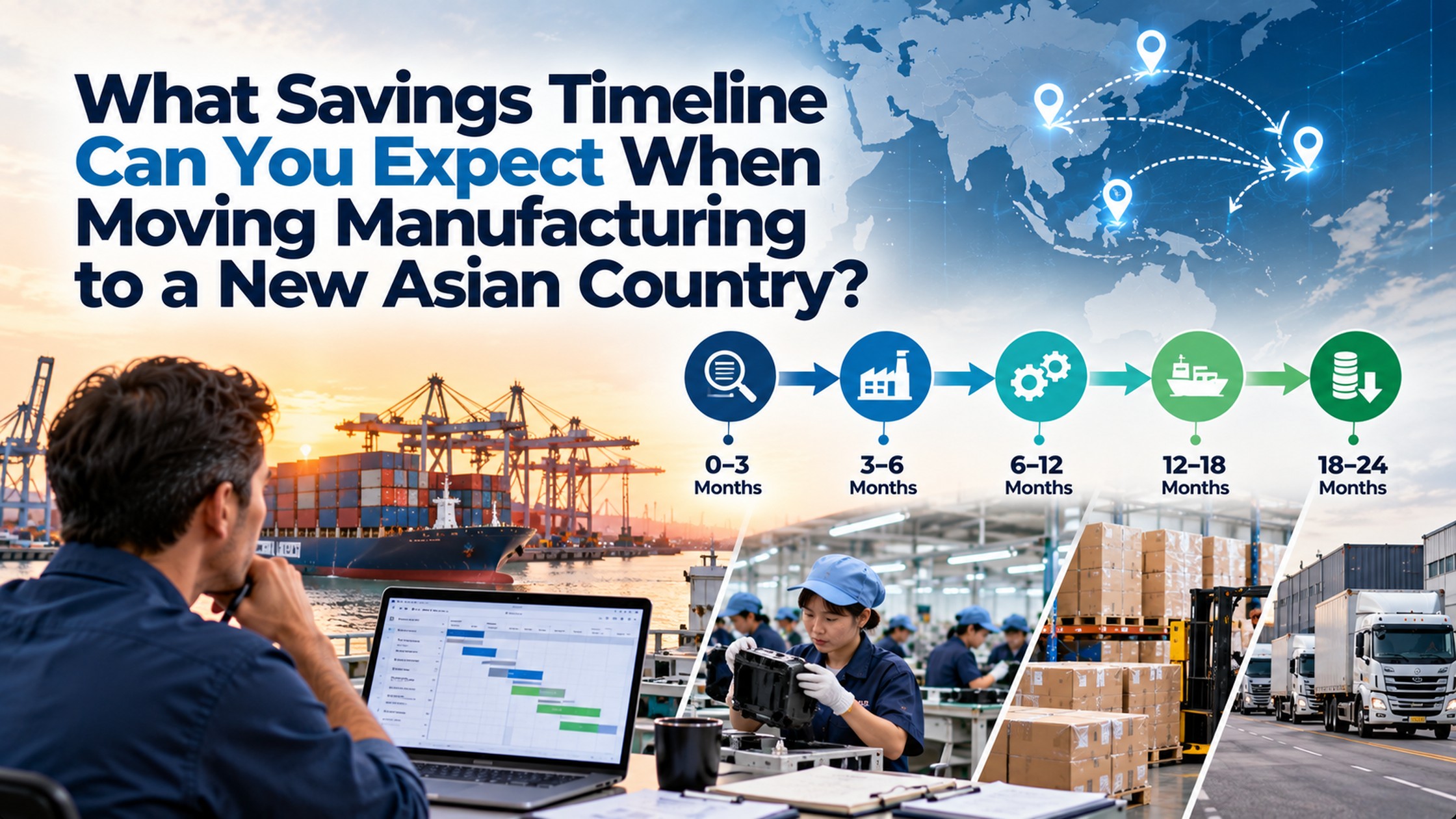

What Savings Timeline Can You Expect When Moving Manufacturing to a New Asian Country?
Quick answer: A realistic savings timeline for moving production to another Asian country is typically 9 to 18 months to achieve stable, meaningful cost reductions. This timeline isn't a promise but an estimate, as it depends heavily on your product's complexity, factory vetting, tooling, and navigating local regulations. A reliable partner focuses on a transparent, phased plan rather than a fixed date.
If you're a VP of Operations, a sourcing director, or a founder under pressure, you're constantly evaluating ways to protect your margins. Rising costs, inconsistent quality from a single supplier, or sudden tariffs can quickly erode your bottom line. Moving your manufacturing to a new country in Asia, like Vietnam, Thailand, or Cambodia, seems like a logical solution. The big question isn't *if* you can save money, but *when* those savings will actually appear on your P&L.
Many consulting firms might offer attractive, aggressive timelines. But a rushed transition can lead to costly mistakes, quality failures, and delays that wipe out any potential savings. The reality is that a successful move requires meticulous planning and on-the-ground management. This is where the approach of a manufacturing partner like Value Source Global makes a difference. Instead of relying on third-party agents, we put our own direct employees in factories across Asia to manage your project from start to finish. This gives you more control and visibility, helping turn a complex, high risk move into a more manageable, strategic advantage.
This article will walk you through the factors that determine a realistic timeline, the common pitfalls that cause delays, and how having a dedicated team on the ground helps you navigate the process. We’ll break down how to plan for a move that not only lowers your landed cost but also builds a more resilient supply chain for the long term.
TL;DR - Quick Takeaways
• Timelines Are Estimates, Not Guarantees: Be cautious of any firm that promises a fixed, rapid savings timeline. A successful relocation to a new Asian country realistically takes 9-18 months to stabilize and show consistent cost benefits.
• Hidden Complexities Cause Delays: The biggest risks to your timeline aren't in the factory itself but in the surrounding details: qualifying new suppliers, navigating local regulations, overcoming cultural and language barriers, and setting up new logistics pathways.
• On the Ground Staff Matters: Having direct employees in the country, as Value Source Global does, can help manage risk and speed up the process. Our teams can address issues in person, oversee quality control directly, and prevent small problems from becoming major delays.
• Focus on Landed Cost, Not Piece Price: True savings come from calculating your total landed cost, which includes production, quality control, shipping, and tariffs. A lower piece price can be misleading if other costs increase.
Why Are Accurate Savings Timelines So Difficult to Predict?
Predicting an exact savings timeline is difficult because every production move involves a unique set of variables that can cause unforeseen delays. These range from factory qualification and tooling transfer to navigating unfamiliar cultural norms, logistics networks, and regulatory environments. A small issue in any one of these areas can have a cascading effect on the entire project schedule.
For operations and procurement leaders, the pressure to deliver cost savings is immense. When a consulting firm presents a timeline that seems too good to be true, it often is. An overly optimistic plan usually ignores the practical realities of setting up a new manufacturing operation overseas. These oversights don't just delay savings; they can actively increase costs as you scramble to fix problems that should have been anticipated.
The transition is not just about finding a new factory. It's about building an entirely new ecosystem for your product. This involves vetting and onboarding component suppliers, establishing quality control protocols, and mapping out a reliable shipping and logistics chain. Each of these steps has its own timeline and potential for setbacks.
What happens if you underestimate the transition time?
Underestimating the transition time is one of the most common and costly mistakes. When you expect savings to kick in within six months but the setup actually takes a year, your business faces a prolonged period of double expenses. You're paying for setup costs in the new location, like tooling, material orders, and staff training, while potentially still managing production or inventory from your old supplier. This puts a significant strain on cash flow and can make the entire project appear to be a failure, even if it's just delayed.
How do cultural and regulatory barriers cause delays?
Every country has its own way of doing business, and these differences can create unexpected friction. In many new markets, building personal relationships and understanding local business culture is important for smooth operations, and that takes time. In Vietnam, navigating the government's regulatory and permitting processes can be complex and requires local knowledge. Misunderstanding local labor laws, public holidays, or even communication styles can lead to compliance issues, employee dissatisfaction, and operational setbacks that push your timeline back by weeks or even months.
What are the hidden complexities in logistics?
Moving production means realigning your entire supply chain. This is far more complex than just booking a new shipping route. You have to consider the new country's infrastructure. Does the region have reliable ports? Is inland transportation efficient, or will your goods get stuck on underdeveloped roads? If your product requires multiple components, you also need to qualify a new network of local sub-suppliers. Building a local supply chain from scratch is a major undertaking that can significantly impact your timeline.
How can financial instability affect your project?
When you move production to an emerging market, you also take on new financial risks. Currency fluctuations are a major factor. Swings in the local currency's value against the dollar can either boost your savings or erode them. A consulting firm that promises quick financial returns may not be adequately accounting for this volatility. Without a strategy to manage currency risk, the financial models that looked so appealing at the start of the project may not reflect reality six months down the road.
What Factors Actually Determine Your Production Relocation Timeline?
Your actual timeline is determined by a sequence of critical, non-negotiable steps: conducting a detailed feasibility study, vetting and qualifying the right factory, developing and approving production tooling, running First Article Testing, and navigating the new country's specific logistics and customs landscape. Each phase must be completed correctly before the next can begin, and rushing any step introduces significant risk.
Think of it less like a race and more like building a house. You can't start framing the walls until the foundation is properly poured and cured. Similarly, you can't start mass production until you have confirmed, with a physical sample in your hands, that the new factory can meet your quality standards. A partner who understands this will guide you through a phased approach, setting realistic milestones for each stage rather than focusing on one final, often arbitrary, date.
The goal is not just to start production quickly, but to start it *correctly*. A well-managed process, even if it takes a few extra months, will deliver sustainable savings and a reliable supply chain. A rushed process often leads to quality problems, rework, and shipping delays that cost you far more in the long run.
How does your product's complexity change the timeline?
The nature of your product is the single biggest factor. A simple product like a basic textile bag with few components might be moved and in production within 6 to 9 months. However, a complex product with custom electronics, multiple molded parts, and a long bill of materials could take 12 to 18 months or more. Complex products require more extensive factory audits to ensure the supplier has the right equipment and technical expertise. They also involve creating and validating new tooling, which is a project in itself.
What is involved in qualifying a new factory?
Finding a factory is easy; qualifying it is hard work. This goes far beyond a simple audit. It involves a deep assessment of their quality management systems, their financial stability, their technical capabilities, and their own supply chain. Your team needs to be on the factory floor to see their processes firsthand. This qualification phase includes negotiating contracts, establishing communication protocols, and ensuring they understand your quality standards. This is a hands on process that takes diligent work before you even place a purchase order.
How long does tooling and First Article Testing take?
If your product requires custom molds or tooling, you must factor in the time to create, test, and approve them. This process can take a significant amount of time, depending on complexity. Once the tooling is ready, the factory will produce the first samples for what's known as First Article Testing & Approval (FAT). This is a critical quality gate. You (or your on-the-ground team) will inspect these first units against your exact specifications. If there are any issues, the factory must adjust the tooling or process and produce new samples. This cycle can repeat several times, adding weeks to the schedule. However, skipping or rushing this step is the primary cause of receiving a shipment of goods that don't meet your quality standards.
Which country-specific factors have the biggest impact?
The country you choose has a huge impact on the timeline. Some countries in Southeast Asia have highly developed manufacturing hubs with good infrastructure, while others are still building theirs out. As noted by the East Asia Forum, the development of manufacturing capabilities across the region is uneven, and each country presents different challenges and opportunities. For example, moving to a well-established industrial zone near a major port in Vietnam will likely be faster than setting up in a more remote region of Cambodia. Local expertise is crucial for understanding these differences and choosing a location that balances cost savings with logistical realities.
How Does a Direct-Control Model Provide a More Realistic Timeline?
A direct-control model, where a manufacturing partner uses its own employees on the ground, provides a realistic timeline by eliminating the communication gaps and delays common with third-party agents. With staff in the same time zone as the factory, speaking the local language, and able to visit the site in person, issues can often be identified and resolved much faster.
This is the core difference in the Value Source Global approach. We operate our own wholly-owned offices in Vietnam, Thailand, Cambodia, and China. When you work with us, it’s our direct employees who are in the factory managing your production. They aren't independent contractors or agents juggling multiple clients. They are your dedicated resource, accountable for executing your project according to a clear, five-step process that we manage from end to end.
This structure gives you direct oversight and control, removing layers of miscommunication and de-risking the entire transition. We provide a clear, transparent plan based on what our teams see on the ground, not on an optimistic sales projection made from an office halfway around the world.
How do direct employees in Asia speed up the process?
Having our own team on the ground fundamentally changes the dynamic. If there’s a question about a sample during First Article Testing, our quality engineer can go to the factory that same day to review it with the production manager. There's no waiting for emails to be answered across a 12-hour time difference. This ability to have real-time, in-person conversations resolves issues faster and keeps the project moving forward. Our employees understand the local business culture and can navigate challenges that would stall an outside team.
What is VSG's five-step process for managing a move?
• Quoting & Sourcing: We start by understanding your product and your target landed cost. We then leverage our network of hundreds of vetted suppliers to find the right factory that fits your specific needs for quality, capacity, and price.
• Factory Vetting & Selection: Our team conducts on-site audits to thoroughly vet potential factories, ensuring they meet our strict standards for quality management and ethical practices. We help you select the best partner for your project.
• Production Management: During production, our on-the-ground staff works directly with the factory to manage schedules, oversee material procurement, and ensure everything stays on track. This includes setting up and managing the critical First Article Testing & Approval process.
• Quality Control: Our own quality inspectors are in the factory checking your product before it ships. We conduct in-process and final inspections to verify that every unit meets your specifications, preventing costly surprises when the goods arrive at your door.
• Logistics & Delivery: We handle all the complexities of shipping, customs, and final delivery to your warehouse. You get a single, clear landed cost and a partner who manages the entire process for you.
How do you protect my product design during the move?
Protecting your intellectual property is a top priority. Because we manage the relationship with the factory directly, we can implement stronger IP protections. Our presence on the ground also acts as a deterrent, as suppliers know they are being actively managed and monitored by your dedicated partner.
How does VSG help calculate the true landed cost?
One of the first questions we help you answer is how to lower your landed cost. A low piece price from a factory is meaningless if you have high shipping costs, unexpected tariffs, or quality issues that require rework. Our quoting process is built around calculating your *total* landed cost from the very beginning. We factor in production costs, raw material sourcing, QC inspections, packaging, shipping, insurance, customs duties, and tariffs. This gives you a clear and accurate financial picture so you can make an informed decision based on real numbers, not just an attractive factory price.
What Is the Smartest Way to Approach a Production Move?
The smartest way to approach a production move is to shift your focus from a promised timeline to the quality of the process and the partner managing it. Prioritize working with a team that has its own employees on the factory floor, offers a transparent, phased approach, and builds a plan based on risk management rather than unrealistic promises.
A successful transition is a complex operational project, not a simple transaction. The right manufacturing partner won’t sell you on a specific date; they will show you a clear, logical plan for getting there. They will be honest about the risks and demonstrate how their on-the-ground presence helps manage them. Ultimately, a well-managed move that takes 12 months will deliver far more value and sustainable savings than a rushed 6-month transition that results in quality failures and supply chain disruptions.
Key takeaways:
• Partner over Promise: Choose a partner based on their process and on-the-ground capabilities, not the aggressiveness of their timeline.
• Control is Key: A direct-control model with in-country employees gives you the visibility and management needed to navigate complexities and avoid costly delays.
• Plan for the Long Term: The goal isn't just to find a cheaper factory; it's to build a resilient, high-quality, and cost-effective supply chain that will support your business for years to come.
If you’re considering a move, tell us about your product and your goals. We'll help you build a realistic plan based on what our teams see on the ground every day in Asia.
Frequently Asked Questions
How long does it typically take to move production to a country like Vietnam or Thailand?
While every project is different, a realistic range is 9 to 18 months to achieve stable, scaled production and see consistent cost savings. Simple products may be on the shorter end of that range, while complex products with custom tooling will be on the longer end.
What's the biggest mistake companies make when moving production?
The most common mistake is focusing only on the quoted piece price from a new factory. This ignores other critical factors that make up the total landed cost, such as logistics, tariffs, and the overhead required for quality control. Another major error is underestimating the time and resources needed to properly vet a new supplier and manage the transition.
Is Value Source Global a sourcing agent?
No. Value Source Global is a manufacturing partner. Unlike sourcing agents who are third-party middlemen, we use our own direct employees, working out of our wholly-owned offices in Vietnam, Thailand, Cambodia, and China, to manage your production directly on the factory floor.
How do you ensure quality is right the first time?
We use a rigorous First Article Testing & Approval process managed by our on-the-ground staff. Before any mass production begins, we work with the factory to produce initial samples, which our teams inspect against your exact specifications. We don't approve full production until you are satisfied with the quality of the first units.
Sources
• China’s manufacturing boom moves the goalposts for Southeast Asian development
Check out our other blog for more information.How Can I Successfully Move Manufacturing and Sourcing Outside of China?
Ready to take the next step? see how we can help, or contact our team to talk through your goals.