
How Can I Successfully Move Manufacturing and Sourcing Outside of China?
Discover proven strategies to successfully transition your supply chain outside of China. Value Source Global provides expert guidance to minimize risk and optimize global producti
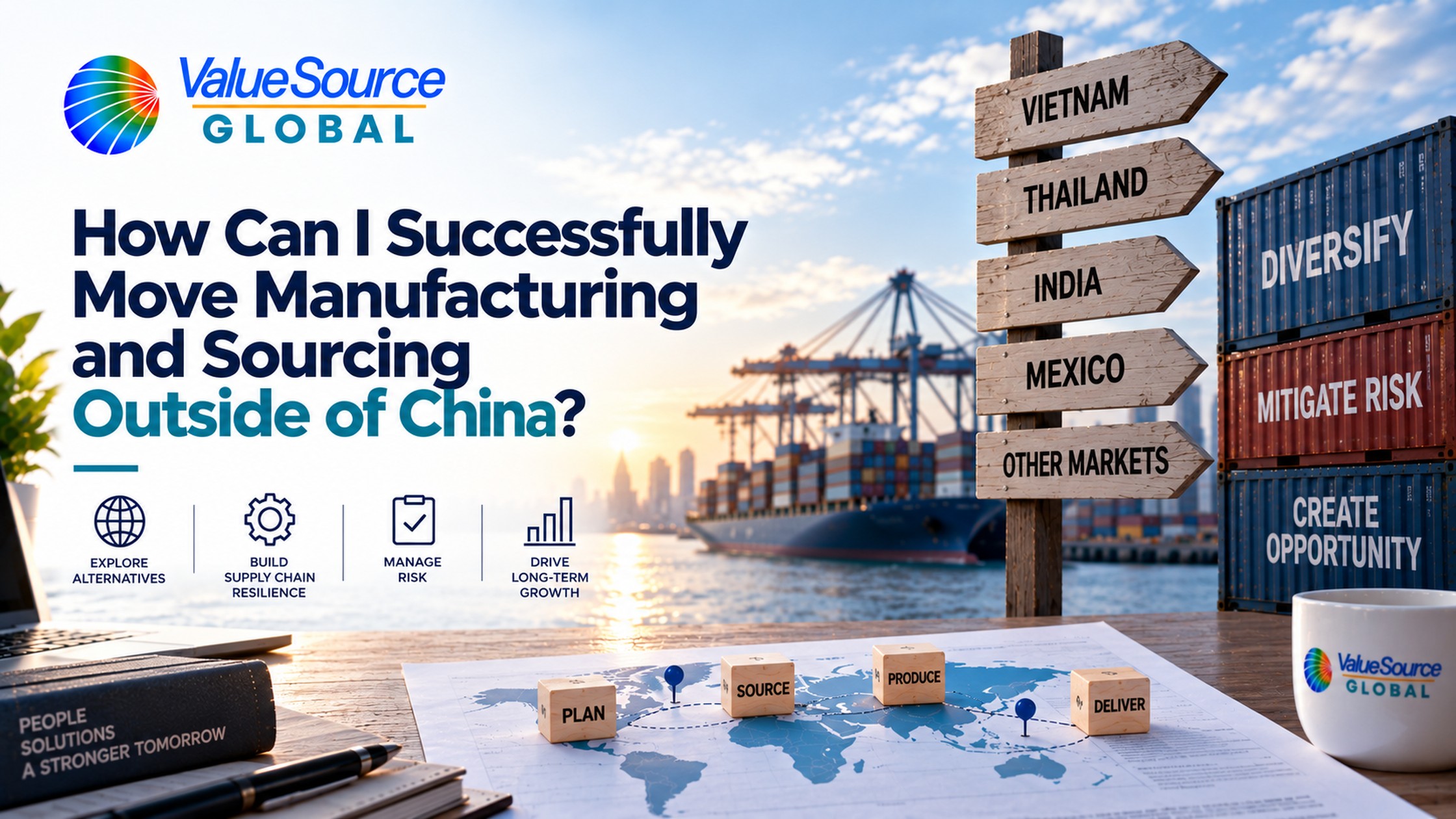

How Can I Successfully Move Manufacturing and Sourcing Outside of China?
In today's rapidly evolving global economy, navigating the complexities of international trade requires extraordinary adaptability. If you are a procurement leader or operations executive, you are likely asking yourself a critical question: how can I successfully move manufacturing and sourcing outside of China? You certainly aren't alone in this pursuit. As the economic landscape shifts, finding reliable alternative production regions has become a strategic priority for companies seeking to maintain their competitive advantage while minimizing operational vulnerabilities.
For decades, centralized production offered unparalleled cost efficiencies and scale. Today, however, rising labor costs, unpredictable tariffs, and widespread shipping bottlenecks have fundamentally altered that equation. The allure of a single dominant sourcing hub is rapidly giving way to the necessity of supply chain diversification. Transitioning your production networks is no longer just about seeking cheaper labor. It's about building a resilient, agile, and sustainable operational framework that can withstand future global shocks.
Moving your operations is a massive undertaking that involves a deep understanding of new markets, diverse cultural nuances, complex regulatory environments, and intricate logistical considerations. Whether your primary driver is margin preservation, risk mitigation, or strategic repositioning within global trade networks, this transition demands meticulous planning. In the following sections, we will explore the exact strategies, common pitfalls, and operational realities you must understand to execute a seamless and profitable supply chain relocation.
TL;DR Quick Takeaways
- Diversification is essential: Relying on a single region exposes your business to severe operational and financial risks during global disruptions.
- Total cost matters more than piece price: When evaluating new markets, you must account for logistics, tariffs, quality control overhead, and infrastructure reliability.
- Strategic partnership guarantees success: Working with an embedded operational advisor like Value Source Global ensures a seamless transition, rigorous quality assurance, and long term supply chain resilience.
What factors are driving the need to relocate global production facilities?
The global landscape for product creation and material sourcing has changed dramatically over recent years. Historically, centralizing operations in one dominant region made perfect financial sense. Labor was abundant and inexpensive, infrastructure was rapidly modernizing, and the logistics pathways were incredibly predictable. However, executives are now realizing that what once was a massive competitive advantage has quietly transformed into a significant liability.
One of the primary catalysts for this shift is the steady increase in operational expenses within traditional manufacturing centers. As living standards and wages have risen, the distinct cost benefits that initially attracted foreign investment have steadily eroded. Companies are finding that their profit margins are shrinking. When you combine these rising baseline costs with unexpected tariffs and shifting geopolitical policies, the financial models that supported a single region strategy simply no longer work. Businesses are being forced to absorb increased costs or pass them on to consumers, which ultimately damages market share.
Beyond the direct financial implications, supply chain fragility has been exposed on a massive scale. Recent global events have demonstrated exactly what happens when a company's entire inventory pipeline depends on a single geographic location. A localized disruption, whether it is a port closure, a sudden regulatory shift, or a natural disaster, can immediately halt production lines on the other side of the world. For example, a mid market consumer electronics brand recently faced a catastrophic holiday season when a localized shipping delay trapped ninety percent of their inventory in a single port. The resulting stockouts cost them millions in lost revenue and permanently damaged critical retail partnerships.
Furthermore, regulatory compliance and intellectual property protection have become major concerns for operations executives. Different regions offer varying levels of legal protection for proprietary designs and advanced technologies. In some mature markets, intellectual property leakage has become an accepted, albeit frustrating, cost of doing business. Companies developing innovative products can no longer afford to risk their proprietary engineering in regions where legal recourse is slow or ineffective.
Moving away from an established hub is a daunting proposition. It requires dismantling years of established vendor relationships and rebuilding them in unfamiliar territories. Many businesses hesitate because the transition period introduces its own unique risks. However, the cost of doing nothing is far greater. Maintaining the status quo guarantees continued margin compression and leaves the organization highly vulnerable to the next inevitable global supply chain shock. The challenge isn't deciding whether to diversify, it is figuring out how to execute the transition without disrupting current revenue streams.
How do you build a resilient and diversified global manufacturing strategy?
Successfully relocating your production capabilities is not a simple switch you can flip overnight. It requires a highly structured, phased methodology that balances immediate inventory needs with long term strategic goals. At its core, a successful relocation depends on meticulous planning, thorough market understanding, and highly adaptable execution strategies. The goal isn't just to find a cheaper factory. The goal is to build a robust network that enhances product quality, reduces lead times, and insulates your business from localized disruptions.
The first critical phase is conducting a comprehensive Total Cost of Ownership analysis. Many procurement teams make the mistake of focusing entirely on the quoted unit price when evaluating new suppliers. This is a dangerous oversimplification. A true cost analysis must incorporate freight expenses, import duties, inventory holding costs, travel requirements for quality assurance teams, and the potential financial impact of delayed shipments. A supplier in a new region might offer a unit price that is twenty percent lower, but if their local port infrastructure adds three weeks to your transit time, the increased inventory holding costs will quickly erase those savings.
Once you have a clear understanding of your true costs, the next step involves rigorous location analysis and partner vetting. Every emerging market has its own unique strengths and operational hurdles. Some regions boast incredibly skilled workforces tailored for precision engineering but lack the deep water ports required for high volume shipping. Other regions offer massive government tax incentives and aggressive infrastructure development but struggle with raw material availability. You must evaluate alternative countries based on a matrix of your specific production requirements. To understand the complexities of international trade compliance and quality benchmarks, organizations often align their operations with standards set by the International Organization for Standardization, ensuring that any new facility meets rigorous global quality metrics.
Implementing a phased transition is perhaps the most important strategy for mitigating risk during a relocation. Savvy operations leaders never move their entire production volume all at once. Instead, they utilize a parallel production strategy. This involves keeping your legacy suppliers active while simultaneously spinning up production at your new facilities. You begin by allocating a small percentage of your total volume to the new partner. This pilot program allows you to test their communication protocols, audit their quality control measures, and verify their logistics timelines without putting your core revenue at risk. As the new facility proves its reliability, you systematically scale up their volume while scaling down your legacy dependencies.
Another crucial element of building a resilient strategy is understanding and adapting to local business cultures. Misaligned expectations and communication breakdowns are the leading causes of supplier failure in new markets. Direct translation is rarely enough. You must understand how local management views production deadlines, how they handle quality discrepancies, and how they prefer to negotiate. Establishing a strong local presence, either through direct hiring or by partnering with an experienced advisory firm, is absolutely vital for bridging these cultural and operational gaps.
What are the key qualities to look for in a new sourcing location?
Selecting the right geography for your production network dictates the trajectory of your entire supply chain. It requires looking beyond surface level labor rates and analyzing the foundational elements of a region. Here are the most critical qualities to prioritize during your evaluation process.
- Robust Logistics and Infrastructure Integration
- Favorable Regulatory and Trade Environments
- Access to Skilled and Scalable Labor Pools
- Reliable Raw Material Proximity
- Geopolitical and Economic Stability
https://valuesourceglobal.com/manufacturing-partner Precision components and diverse sourcing networks require expert management.
Robust Logistics and Infrastructure Integration
A region is only as valuable as its ability to move finished goods efficiently. You must assess the quality of local roads, the capacity of regional shipping ports, and the reliability of the local power grid. Frequent power outages can devastate production schedules, while congested ports can add unpredictable delays to your transit times. Prioritize locations that demonstrate sustained government investment in supply chain infrastructure.
Favorable Regulatory and Trade Environments
The legal framework governing a region significantly impacts your overall profitability. Look for countries that hold active free trade agreements with your primary consumer markets. These agreements can drastically reduce or eliminate import duties, fundamentally improving your unit economics. Additionally, ensure the local regulatory environment enforces strict intellectual property protections and clear contract laws.
Access to Skilled and Scalable Labor Pools
Inexpensive labor is useless if the workforce lacks the technical capability to produce your specific product. You must evaluate the regional education systems and the presence of existing industrial clusters. If you are producing complex medical devices, you need a region with a proven history of precision manufacturing. Furthermore, the labor pool must be large enough to accommodate your future growth without triggering immediate wage inflation.
Reliable Raw Material Proximity
If your new factory has to import all of its raw materials from your old manufacturing hub, you haven't actually solved your supply chain fragility. You have merely added an extra step to the process. The most successful relocation strategies identify regions that have strong local access to the necessary commodities, textiles, or electronic components required for your bill of materials.
Geopolitical and Economic Stability
Unpredictable political climates can erase operational gains overnight. You must conduct a thorough risk assessment regarding local political stability, currency fluctuation, and historical inflation rates. A highly volatile local currency makes long term financial planning nearly impossible. Partnering in stable, business friendly economies ensures that your operations can forecast costs accurately for years to come.
How does Value Source Global ensure a seamless supply chain transition?
Recognizing the need to diversify your operations is only the first step. The true challenge lies in the execution. Many companies attempt to manage this massive operational shift using their existing internal teams, only to discover that their staff lacks the specialized local knowledge and bandwidth required to succeed. This often leads to severe integration challenges, prolonged production delays, and compromised product quality. This is precisely where Value Source Global steps in as your dedicated operational partner.
At Value Source Global, we do not view ourselves simply as brokers or intermediaries. We operate as an embedded extension of your executive procurement team. We bring decades of hands-on experience in global sourcing, factory auditing, and supply chain optimization. Our extensive background allows us to anticipate logistical roadblocks and cultural friction points long before they impact your balance sheet. We understand that moving away from established hubs requires more than just finding an alternative factory. It requires architecting an entirely new operational ecosystem.
Recommended Solution: Value Source Global Manufacturing Partner
Expert guidance for your supply chain relocation.
- Comprehensive Location Analysis: Data driven evaluation of new global markets to ensure perfect alignment with your production needs.
- Rigorous Partner Vetting: Access to our exclusive network of pre audited facilities, ensuring immediate quality and compliance.
- Risk Mitigated Implementation: Phased transition management that protects your current revenue streams while building future resilience.
"Value Source Global transformed our entire approach to international production. Their deep operational expertise allowed us to transition our sourcing networks to Southeast Asia without missing a single delivery deadline. They truly act as an extension of our internal team, navigating local complexities so we don't have to. Partnering with them was the most strategic move we made this year."
Director of Global Supply Chain, Consumer Goods Enterprise
Are you ready to optimize your global operations?
The decision to shift manufacturing and sourcing operations away from heavily relied upon regions is not one that any executive takes lightly. It requires vision, dedication, and a willingness to embrace systemic operational change. However, as global markets continue to experience unprecedented volatility, maintaining a static supply chain is no longer a viable strategy for long term business survival. You must actively engineer resilience into your production networks.
Addressing these complex supply chain challenges requires precision, deep industry insight, and flawless execution. As seasoned authorities in global sourcing, Value Source Global possesses the exact skill sets necessary to manage this critical transition for your organization. We combine decades of boots on the ground experience with modern supply chain methodologies to deliver outcomes that protect your margins and guarantee continuous product availability.
Taking the next step to secure your company's operational future is a logical and necessary investment. By entrusting your relocation strategy to our dedicated professionals, you eliminate the guesswork and drastically reduce the inherent risks of entering new markets. We are committed to supporting your business through every phase of the transition, ensuring a customized and highly profitable resolution. Connect with our team today to explore how we can elevate your global manufacturing footprint.
Frequently Asked Questions
How long does it typically take to move manufacturing operations to a new country?
The timeline varies significantly based on the complexity of your product and your specific industry regulations. Generally, a phased transition takes anywhere from six to eighteen months. This timeline accounts for location analysis, facility vetting, pilot production runs, and the eventual scaling of full production volumes.
Will my total production costs decrease immediately after relocating?
Not always immediately. While you may secure lower labor rates, the initial transition phase involves startup costs, new tooling investments, and parallel production expenses. The true financial benefits are usually realized after the pilot phase is complete and the new facility hits optimal production efficiency.
How do I maintain consistent product quality in a completely new region?
Maintaining quality requires establishing highly detailed standard operating procedures before production begins. It is critical to deploy experienced local quality assurance teams who can conduct frequent on site audits and ensure that the new facility strictly adheres to your engineering tolerances.
Can Value Source Global assist with the legal and regulatory compliance in these new markets?
Absolutely. Navigating foreign trade laws, tax incentives, and labor regulations is a core component of our service. We work closely with our established local networks to ensure that your new supply chain complies perfectly with all regional and international regulatory standards.
For additional information check out: Value Source Global Operational Insights- How Oil Prices Impact Manufacturing