
What Do China's New Export Controls Mean for Your Supply Chain?
Discover how China's export controls impact your sourcing strategy. Learn how to build resilience in your supply chain.
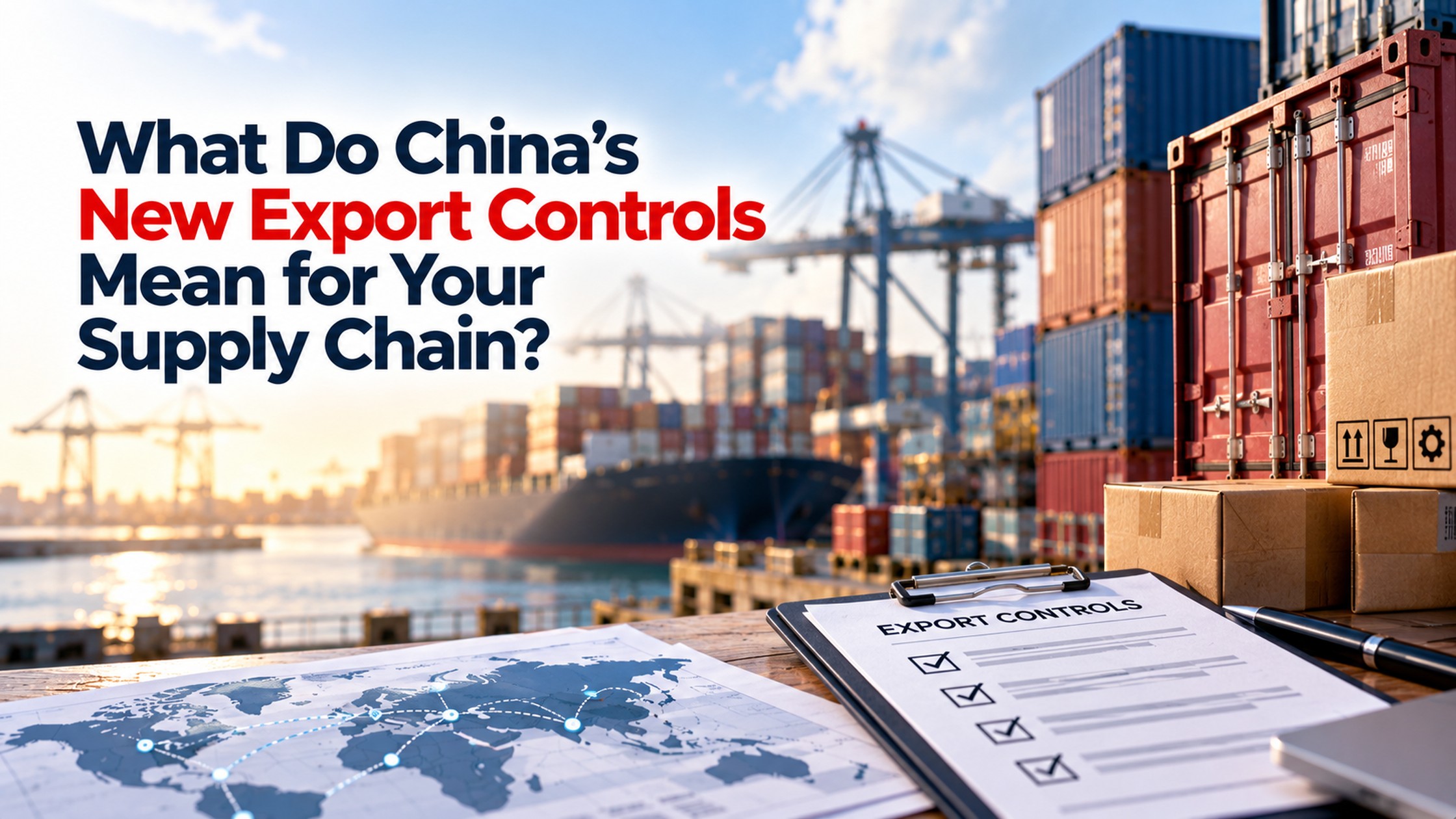

What Do China's New Export Controls Mean for Your Supply Chain?
Quick answer: China's wider export controls mean increased risks for divisions still sourcing components from the region. These controls can cause production delays, raise costs, and create supply chain uncertainty. To protect margins and ensure on-time delivery, companies must shift from a single-country dependency to a diversified, multi-country sourcing strategy managed by an experienced manufacturing partner.
For any leader managing a supply chain, the pressure is constant. You’re balancing costs, delivery dates, and the quality your customers expect. Now, new challenges are making that job even harder. Understanding what China's wider export controls mean for divisions still sourcing components from China isn't just an academic exercise, it's critical to protecting your business from serious disruption. These evolving regulations create new risks that can halt production lines, inflate costs overnight, and put hard-won market share in jeopardy.
The days of relying on a single region for critical components are becoming too risky. A sudden policy change can leave you scrambling for new suppliers, dealing with inconsistent quality, or facing unexpected tariffs that destroy your margins. This is often the trigger that forces VPs of Operations and Directors of Supply Chain to look for a more resilient path forward. At Value Source Global, we see these challenges every day. We help companies build stronger, more flexible supply chains through a clear, multi-country sourcing strategy.
We act as your dedicated manufacturing partner, not just a sourcing agent. Our on-the-ground teams in multiple countries manage quality control, help mitigate risk, and work to keep your products delivered on time and to spec. We provide the operational expertise and global network you need to navigate this new landscape with confidence. Your product. Our manufacturing expertise. Enterprise value delivered.
TL;DR - Quick Takeaways
• Increased Risk: China's new export controls create significant uncertainty, threatening delays, higher costs, and potential production stoppages for companies that depend on Chinese suppliers.
• Single-Source Danger: Over-reliance on any single country for critical components is now a major business vulnerability. Geopolitical shifts can disrupt your entire operation without warning.
• Strategic Diversification is Key: The solution isn't just finding another supplier; it's building a resilient, multi-country sourcing strategy that provides flexibility, stability, and long-term value.
Why are China's export controls a growing concern for manufacturers?
China's export controls are a growing concern because they introduce unpredictable variables into the global supply chain. These regulations, designed to protect national security and strategic industries, can restrict the flow of critical materials and technologies with very little warning, creating immediate operational and financial risks for businesses.
For years, sourcing from China was a straightforward strategy to manage costs. But the global landscape has changed. Geopolitical tensions and national interests are now driving trade policy, and manufacturing leaders are feeling the impact directly. These controls aren't just paperwork; they are tools that can be used to limit access to everything from rare earth minerals used in electronics to specific types of manufacturing equipment.
This creates a new layer of uncertainty. A component that was readily available last month might be on a restricted list next month. This forces companies to ask hard questions about their supply chain vulnerabilities and whether their current strategy can withstand sudden shocks.
What are the most common operational risks?
The most immediate operational risk is a sudden production halt. If a critical component becomes unavailable due to an export restriction, your assembly line can grind to a stop. This leads to missed deadlines, unfilled orders, and damaged relationships with customers who rely on your products.
Imagine a consumer electronics company preparing to launch a new device. The entire product depends on a specific semiconductor sourced from China. If that component is suddenly placed under an export control, the launch is delayed, competitors gain an advantage, and millions in projected revenue are lost. This isn't a theoretical problem; it's a real-world scenario that keeps supply chain managers up at night.
How do these controls affect a company's finances?
The financial impacts are significant and multi-faceted. First, there are the direct costs of compliance. Navigating complex legal frameworks requires time and expertise, often leading to new overhead for legal teams or consultants. Second, tariff uncertainty can destroy profitability. A sudden tariff spike can erase your margins on a product line instantly.
Beyond these direct costs, the scramble to find new suppliers in a crisis is often expensive. You lose negotiating power and often have to pay a premium for rush orders. This financial strain puts immense pressure on mid-market manufacturers who are already operating with tight margins, making it harder to invest in growth and innovation.
Can these changes create long-term strategic damage?
Absolutely. The long-term damage often outweighs the immediate financial hit. Consistently missing delivery dates erodes customer trust, which is incredibly difficult to win back. A delayed product launch can mean losing your first-mover advantage in a competitive market, a strategic setback that can take years to recover from.
Furthermore, making rushed decisions to find alternative suppliers can expose your company to intellectual property (IP) risks. In the hurry to get production back online, you might partner with a less-reputable factory, putting your proprietary designs and technology at risk of being stolen or copied. This kind of damage can undermine your core competitive advantage.
What mistakes do companies make when responding to supply chain disruptions?
The most common mistake companies make is being reactive instead of proactive. They wait for a disruption to happen, like a new export control, and then scramble to find a solution. This crisis-mode approach leads to poor decisions, higher costs, and greater overall risk to the business.
Many businesses fall into the trap of thinking their current supply chain is "good enough" because it hasn't failed yet. They might rely on a single, long-term supplier in China and assume that relationship will protect them. But in today's environment, loyalty can't shield you from national policy changes. A proactive approach involves constantly assessing risk and building a flexible system before you actually need it.
Why is a "wait and see" approach so risky?
A "wait and see" approach is risky because it leaves you with no time to make strategic choices. When a restriction is announced, the clock starts ticking. The cost of air freight can rise sharply. The best alternative suppliers can quickly be contacted by many other companies in the same position. By waiting, you can end up at the back of the line with fewer options, often at a higher price and lower quality.
Being proactive means you've already identified and vetted alternative suppliers in different countries. You have a plan ready to execute. This allows you to pivot smoothly, protecting your production schedule and your bottom line from the chaos that reactive companies face.
What happens when businesses ignore local expertise?
Ignoring local, on-the-ground expertise is a critical error. Export control regulations are often complex and written in legal language that can be difficult to interpret from afar. As noted in a guide on China's legal framework for sanctions and supply chain risks, these developments strengthen the case for more deliberate conflict-of-laws analysis and carefully designed escalation protocols. Without it, companies can easily misinterpret a rule, fill out paperwork incorrectly, or fail a compliance check. The result? Your goods can be held in customs, creating delays and added costs.
An experienced partner with teams on the ground understands the nuances of local regulations and has relationships with local authorities. This expertise helps your shipments comply with requirements and move more smoothly across borders.
Is diversifying suppliers enough to solve the problem?
No, simply finding a second supplier is not a complete strategy. This is a common misunderstanding of diversification. True supply chain resilience comes from *strategic* diversification. This means not just having a backup supplier, but having suppliers in different geographic regions to protect against country-specific risks like tariffs, natural disasters, or political instability.
This is the core idea behind a "China+1" strategy. It's not about abandoning China entirely, but about building out your supply chain in another country, like Vietnam, Mexico, or India, to create balance and flexibility. This approach reduces your dependency on any single economy and gives you the agility to shift production as global conditions change.
How can a rushed transition create new problems?
When you're forced to make a fast transition, due diligence often gets skipped. This creates a host of new risks. You might partner with a factory that can't meet your quality standards, leading to a surge in product defects and customer complaints. You might choose a supplier with an unethical labor record, damaging your brand's reputation. Or, as mentioned earlier, you could expose your valuable IP to a company without proper safeguards.
A well-managed transition takes time. It involves rigorous factory audits, quality control checks, and building a strong working relationship. Rushing the process means you're often just trading one set of problems for another, sometimes worse, set of problems.
How does a manufacturing partner help navigate these export controls?
A true manufacturing partner helps you navigate export controls by transforming your supply chain from a vulnerability into a strategic asset. Instead of just finding factories, a partner provides the on-the-ground expertise, risk management framework, and global network needed to build a resilient, multi-country sourcing strategy.
The value of a partner like Value Source Global is our ability to see the big picture. We don't just solve today's problem; we build a system designed to protect you from tomorrow's surprises. Our approach is built on decades of experience managing complex global supply chains. We handle the operational details of risk, quality, and logistics so you can focus on growing your business with confidence.
What does a proactive sourcing strategy look like?
A proactive strategy begins with a deep analysis of your current supply chain. Our process starts with Assessment & Diagnosis. We map out every component, supplier, and logistical step to identify your single points of failure. Where are you most exposed to tariffs? Which components have no backup supplier? Where could a political disruption halt your entire operation?
By answering these questions before a crisis hits, we can build a clear roadmap for strengthening your supply chain. This isn't a one-size-fits-all plan; it's a tailored strategy based on your specific products, markets, and risk tolerance.
How do you build a more resilient supply chain?
We build resilience through strategic diversification. Based on our assessment, our Strategy Development phase focuses on creating a multi-country supplier base. This "China+1" or "China+2" approach reduces your dependence on any single region. We leverage our network of vetted factories across Asia and other parts of the world to find the right partners for your products.
This does more than just reduce risk. It often unlocks new advantages, such as access to different trade agreements, lower labor costs, or proximity to new markets. The goal is a balanced, flexible supply chain that can adapt to a changing world.
What ensures quality and on-time delivery during a transition?
This is where our on-the-ground presence is critical. During the Implementation & Execution phase, our local teams and staff manage the entire process. Our engineers work with new factories to help make sure your quality standards are met from day one. Our logistics experts coordinate shipments to help keep the transition smooth and minimize disruption to your delivery schedules.
This hands-on management helps reduce the quality issues and delays that often plague rushed transitions. We're your eyes and ears on the factory floor, helping make sure your product is made to spec and shipped on time. You don't trade one problem for another; you get a better, more reliable system.
How do you stay ahead of future changes?
A resilient supply chain is not a "set it and forget it" project. The global trade landscape is always changing. Our final step, Monitoring & Optimization, is an ongoing process. We constantly monitor geopolitical trends, trade policies, and supplier performance to anticipate future risks.
This continuous risk management allows us to adapt your strategy as needed. If new tariffs are announced or a supplier's performance dips, we can proactively shift production to other partners in your network. This helps your supply chain remain a source of strength and competitive advantage, not a source of stress.
What is the most important takeaway for leaders managing global sourcing?
The most important takeaway is that supply chain resilience is no longer optional. The era of relying on a single country for low-cost manufacturing is over. To protect your business and drive long-term growth, you must build a diversified, flexible, and professionally managed global sourcing strategy.
The shift in global trade, highlighted by China's wider export controls, represents a fundamental change in how businesses must operate. Success is no longer just about finding the cheapest supplier. It’s about building a smart, resilient system that can withstand geopolitical shocks, manage quality across multiple regions, and deliver consistent value to your customers. This requires foresight, expertise, and a strong partnership.
This transition may seem daunting, but you don't have to do it alone. Working with a dedicated manufacturing partner like Value Source Global provides the operational backbone and strategic guidance needed to navigate this complexity. We make global sourcing feel clear, safe, and results-driven, allowing you to grow with confidence.
Key takeaways:
• Single-country dependency is a major business risk in the current geopolitical climate.
• A proactive, multi-country sourcing strategy is essential for protecting margins and supporting on-time delivery.
• True resilience requires more than just finding new suppliers; it requires on-the-ground management of quality, logistics, and risk.
Building a resilient supply chain is one of the most important strategic decisions you can make for the future of your business.
Frequently Asked Questions
What specific components are most affected by China's export controls?
The list is dynamic and can change based on geopolitical factors.
Is moving all manufacturing out of China the only solution?
Not necessarily. For many companies, a "China+1" or "China+2" strategy is a more practical and resilient approach. This involves diversifying your supplier base to include factories in other countries (like Vietnam, India, or Mexico) while still maintaining some manufacturing relationships in China. This creates balance and reduces risk without a complete operational overhaul.
How long does it take to diversify a supply chain?
The timeline depends on the complexity of your product and production requirements. However, working with an experienced manufacturing partner like VSG can significantly speed up the process. Our established network and structured methodology help plan and execute a transition in months, not years, while minimizing disruption to your business.
What's the difference between a sourcing agent and a manufacturing partner?
A sourcing agent is typically transactional; their main job is to find a factory for a fee. A manufacturing partner like Value Source Global is a strategic, long-term extension of your team. We manage the entire production lifecycle, including quality assurance, logistics, risk mitigation, and continuous improvement, delivering greater enterprise value.
Check out our other blog for more information.Sourcing from China: Geopolitical Risks and Trade Barriers in 2025 - Insights - Value Source Global