
Sourcing Agent vs Contract Manufacturer: Navigating Your Supply Chain Strategy
Learn how to choose between a sourcing agent and a contract manufacturer to optimize global production, reduce risks, and scale your supply chain effectively.

In the rapidly evolving global business landscape, making informed decisions about production and supply chain management is crucial for maintaining a competitive edge. Organizations constantly grapple with the intricacies of product development and scaling operations. When navigating these complexities, choosing between a sourcing agent vs contract manufacturer is a decision that holds the key to unlocking efficiency, optimizing costs, and ensuring consistent product quality.
Companies need to approach this choice with acute precision to sustain their growth trajectories. Strategic missteps in procurement can lead to increased costs, severe product delays, and compromised quality. All of these negative outcomes can have a profound impact on a brand’s reputation and financial bottom line. Understanding the distinct roles that sourcing agents and contract manufacturers play in your broader supply chain strategy is a fundamental requirement for modern operations executives.
At Value Source Global, we understand the distinct challenges businesses face during this critical decision-making process. We do not just act as an external vendor. We embed ourselves as a strategic advisor. Our experienced professionals are committed to demystifying global production complexities and empowering organizations to make informed, data-driven choices. By ensuring you are well-versed in the crucial operational differences between sourcing agents and contract manufacturers, we equip you with the knowledge necessary to drive your business forward with confidence.
TL;DR – Quick Takeaways
- Sourcing agents facilitate relationships and negotiate with global suppliers while contract manufacturers directly operate the facilities producing your goods.
- Misaligned partnerships frequently result in supply chain bottlenecks, unpredictable lead times, and rising manufacturing costs.
- Value Source Global provides embedded operational guidance to help you select the exact partners needed to build a resilient and scalable supply chain.
What Operational Challenges Drive This Strategic Decision?
In today's global market, businesses often struggle with strategic decisions regarding procurement and long-term production scalability. A critical juncture that many companies face involves identifying the precise operational gaps in their current workflow. You might recognize the symptoms easily. Manufacturing costs keep rising uncontrollably. Your company is too dependent on one supplier or a single geographic region. Quality issues are becoming more frequent, and lead times are increasingly unpredictable.
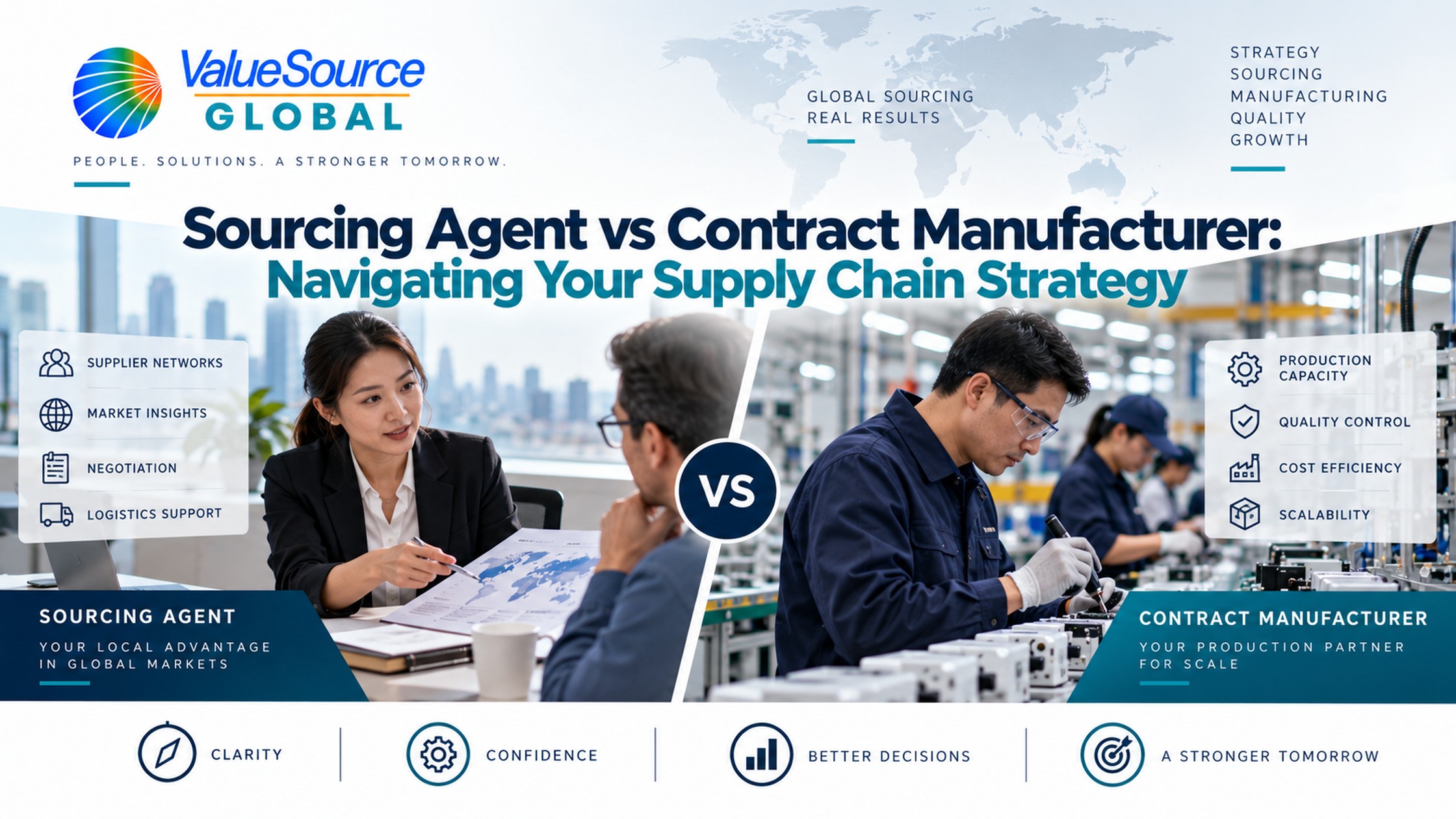
These pain points force procurement leaders to evaluate their external partnerships. While both sourcing agents and contract manufacturers offer unique structural advantages, they also present distinct challenges that can lead to significant operational and financial risks if they are not managed correctly. A core struggle for many executives is misunderstanding the functional capacities of these two entities. A sourcing agent specializes in finding, auditing, and negotiating with various suppliers across a region. In contrast, a contract manufacturer focuses almost entirely on the physical production of goods within their own facilities.
Overlapping or misaligned expectations between your company and your chosen partner will inevitably result in production delays and quality control failures. For instance, companies often encounter severe problems when the operational objectives of a sourcing agent do not align with the capabilities of a selected contract manufacturer. A retail brand might work with a sourcing agent who strictly emphasizes low upfront costs. If that agent selects a contract manufacturer incapable of maintaining the brand's required quality standards, the misalignment will damage the brand's reputation and result in widespread customer dissatisfaction.
Furthermore, businesses frequently struggle with poorly defined international agreements. Vague terms lead to complex disputes over quality control procedures, production timelines, and intellectual property rights. A technology startup might face catastrophic setbacks if their manufacturing agreement lacks clarity on who legally owns the custom design of a manufactured component. This ambiguity can trigger extended legal battles and complete production halts.
Relying heavily on either a sourcing agent or a single contract manufacturer without building a resilient backup plan exposes businesses to devastating supply chain disruptions. Consider a consumer goods company that depends entirely on one regional contract manufacturer. Political instability, changing tariff regulations, or natural disasters in that specific region could severely impact their product availability. Making the right strategic choice and building a resilient network is essential for operational efficacy and long-term financial health.
How Do You Differentiate Between These Strategic Roles?
In the global supply chain ecosystem, understanding the granular mechanics of your production strategy is pivotal to your business's success. This requires more than just a surface-level grasp of your production needs. It requires a comprehensive understanding of each partner's operational capabilities, financial structures, and risk mitigation protocols. Let us explore the nuances of these roles to highlight how strategic expertise ensures effective decision-making.
A sourcing agent serves primarily as a strategic intermediary. They dedicate their expertise to finding the most suitable suppliers, negotiating favorable pricing models, and ensuring localized compliance with your quality standards. They act as your eyes and ears on the ground in foreign markets. Sourcing agents are highly beneficial for companies that lack internal procurement teams or regional expertise. They manage the complex logistics of cross-border trade, oversee factory audits, and coordinate multiple suppliers if your product requires components from different specialized facilities.
Conversely, a contract manufacturer focuses entirely on the physical fabrication and assembly of your goods. They often provide localized engineering support, tooling setup, and dedicated production lines under one roof. When you hire a contract manufacturer, you are essentially renting their factory space, their workforce, and their production machinery. They are responsible for turning raw materials into finished products based exactly on the specifications you provide.
Inexperienced companies frequently confuse these two distinct functions. This confusion leads to mismatched partnerships that compromise both production efficiency and product quality. For example, assigning complex supply chain logistical planning to a contract manufacturer whose sole expertise is plastic injection molding will likely result in delayed shipping and unoptimized freight costs. According to experts in global trade and logistics, organizations that clearly define partner roles build far more resilient networks. You can read more about building operational resilience in strategies published by the Harvard Business Review.
Successful outcomes in global sourcing hinge on carefully aligning your internal business needs with the external service provider's proven capabilities. For businesses lacking the in-house resources to manage complex supplier relationships, a strategic sourcing agent streamlines the entire procurement process. Conversely, if you have a highly detailed product design and an internal team capable of managing global logistics, partnering directly with a well-suited contract manufacturer can optimize the manufacturing cycle and reduce your time-to-market.
What Key Qualities Should You Look For?
Whether you are evaluating a sourcing agent or auditing a potential contract manufacturer, specific operational qualities separate reliable partners from risky vendors. Identifying these traits early in the procurement process will save your organization significant time and capital.
- Operational Transparency
- Scalable Production Capabilities
- Comprehensive Risk Management
- Embedded Quality Assurance
- Long-Term Strategic Alignment
https://valuesourceglobal.com/value-generation — Optimize costs and build supply chain resilience with strategic manufacturing partnerships.
Why is Operational Transparency Critical?
Transparency is the foundation of any reliable manufacturing partnership. A trusted partner will provide clear visibility into their pricing structures, material origins, and factory conditions. If a sourcing agent refuses to disclose the exact factory producing your goods, you are exposing your brand to massive compliance and quality risks. True partners operate with open books and welcome independent facility audits.
How Do Scalable Production Capabilities Impact Growth?
Your chosen partner must be able to grow alongside your business. A contract manufacturer might be able to handle your initial pilot run of one thousand units perfectly. However, if they lack the machinery, workforce, or financial stability to scale up to fifty thousand units during your peak season, they will become a bottleneck. Evaluating a partner's maximum capacity and lead time flexibility is a non-negotiable step in the vetting process.
What Does Comprehensive Risk Management Look Like?
Global supply chains are inherently vulnerable to geopolitical shifts, currency fluctuations, and logistical disruptions. A mature sourcing partner proactively identifies these risks and builds contingency plans. They do not just react to problems when shipments are delayed. They actively monitor regional stability, diversify raw material sources, and implement dual-sourcing strategies to ensure your production line never stops.
Why Must Quality Assurance Be Embedded?
Quality control cannot be an afterthought tacked onto the end of the production line. It must be embedded into every step of the manufacturing process. Whether you are using a sourcing agent to monitor multiple facilities or working directly with a contract manufacturer, they must utilize rigorous inspection frameworks. This includes incoming material validation, in-line inspections, and comprehensive pre-shipment testing.
How Does Long-Term Strategic Alignment Benefit You?
The most successful global brands do not treat their manufacturers as disposable vendors. They view them as long-term strategic partners. When your sourcing agent or contract manufacturer deeply understands your industry, your target audience, and your financial goals, they can offer proactive engineering improvements and cost-saving recommendations that a purely transactional vendor would overlook.
Several common missteps can easily derail the process of selecting between a sourcing agent and a contract manufacturer. Companies frequently fail to define their project requirements accurately. Cutting corners by simply opting for the cheapest initial quote without analyzing logistics, quality risks, and long-term value always leads to inferior product quality. Small businesses also mistakenly solicit one party to perform tasks outside of their core competencies. You must conduct a thorough needs assessment to define your product requirements and distribution goals before signing any international agreements.
How Does Value Source Global Optimize Your Network?
In the complex arena of global trade and manufacturing, companies need a partner that understands the operational realities of the factory floor as well as the strategic goals of the boardroom. At Value Source Global, we specialize in simplifying this critical decision-making process. We leverage our decades of deep supply chain expertise and our highly structured approach to add measurable value at every single step of your procurement journey. Our Value Generation service is meticulously designed to mitigate operational risks, maximize corporate profitability, and structurally optimize your entire supply chain.
Our methodology focuses strictly on aligning with your long-term business objectives. We provide practical, tailored solutions that cater to your specific market needs. The core of our service lies in providing expert operational consultation and flawless execution. We help you evaluate your internal bandwidth and operational goals to choose the most suitable path between utilizing a sourcing agent or partnering directly with a contract manufacturer.
Recommended Product: https://valuesourceglobal.com/value-generation
Strategic Value Generation Services
- Comprehensive Network Auditing: Identify and eliminate inefficiencies within your current supplier network to reduce ongoing production costs.
- Strategic Partner Matching: Align your exact product specifications with thoroughly vetted manufacturing facilities capable of scaling with your growth.
- Embedded Quality Control: Implement rigorous, multi-stage inspection frameworks to ensure product consistency and protect your brand equity.
"Partnering with Value Source Global completely transformed our approach to overseas production. Their operational intelligence and deep understanding of both sourcing agents and contract manufacturing gave our executive team the clarity we needed. We successfully mitigated our regional risks, stabilized our lead times, and built a highly resilient supply chain built for long-term scale."
Operations Director, Global Consumer Goods Brand
Are You Ready to Transform Your Sourcing Strategy?
Tackling global supply chain complexities accurately is of paramount importance for any growing enterprise. The intricacies of deciding between a sourcing agent and a contract manufacturer require a nuanced understanding of international trade, factory operations, and strategic risk mitigation. This is precisely where the seasoned expertise of Value Source Global comes into play. We pride ourselves on a proven track record of effectively solving complex manufacturing challenges, ensuring operational outcomes that consistently exceed the expectations of our clients.
Our team comprises dedicated professionals who have honed their skills through decades of hands-on experience managing global production programs. This real-world experience positions us uniquely to provide strategic solutions that are both highly innovative and firmly rooted in practical reality. By entrusting your supply chain architecture to our capable hands, you ensure that your procurement issues are resolved correctly the very first time.
Your confidence in moving forward with a professional sourcing implementation should be rooted in the understanding that our specialized services do more than just facilitate transactions. We add compounding value through expert insights, rigorous quality control systems, and transparent communication. By choosing Value Source Global, you are making a logical, data-driven decision that aligns your operations with the highest industry standards. Let us help you transform your potential supply chain vulnerabilities into powerful competitive advantages.
Frequently Asked Questions
What is the main difference between a sourcing agent and a contract manufacturer?
A sourcing agent acts as an intermediary who finds, audits, and negotiates with multiple suppliers on your behalf. A contract manufacturer directly owns and operates the factory that produces your goods.
When should a company hire a sourcing agent?
You should hire a sourcing agent if you lack an internal procurement team, need to source components from multiple different factories, or require local expertise to navigate foreign market regulations and language barriers.
Can a contract manufacturer help with product design?
Yes, many mature contract manufacturers offer engineering and design-for-manufacturing services to help optimize your prototype for mass production, though their primary focus remains on physical assembly.
How does Value Source Global reduce supply chain risks?
Value Source Global reduces risk by conducting exhaustive due diligence on all potential partners, negotiating clear contractual terms, and implementing rigorous, multi-stage quality assurance protocols before any shipments leave the facility.
For additional information check out: Insights on Global Supply Chain Optimization