
Decoupling vs. De-Risking: What's the Difference and Which Does Your Mandate Require?
Explore the difference between decoupling and de-risking. Learn how to determine the best strategy for your mandate.
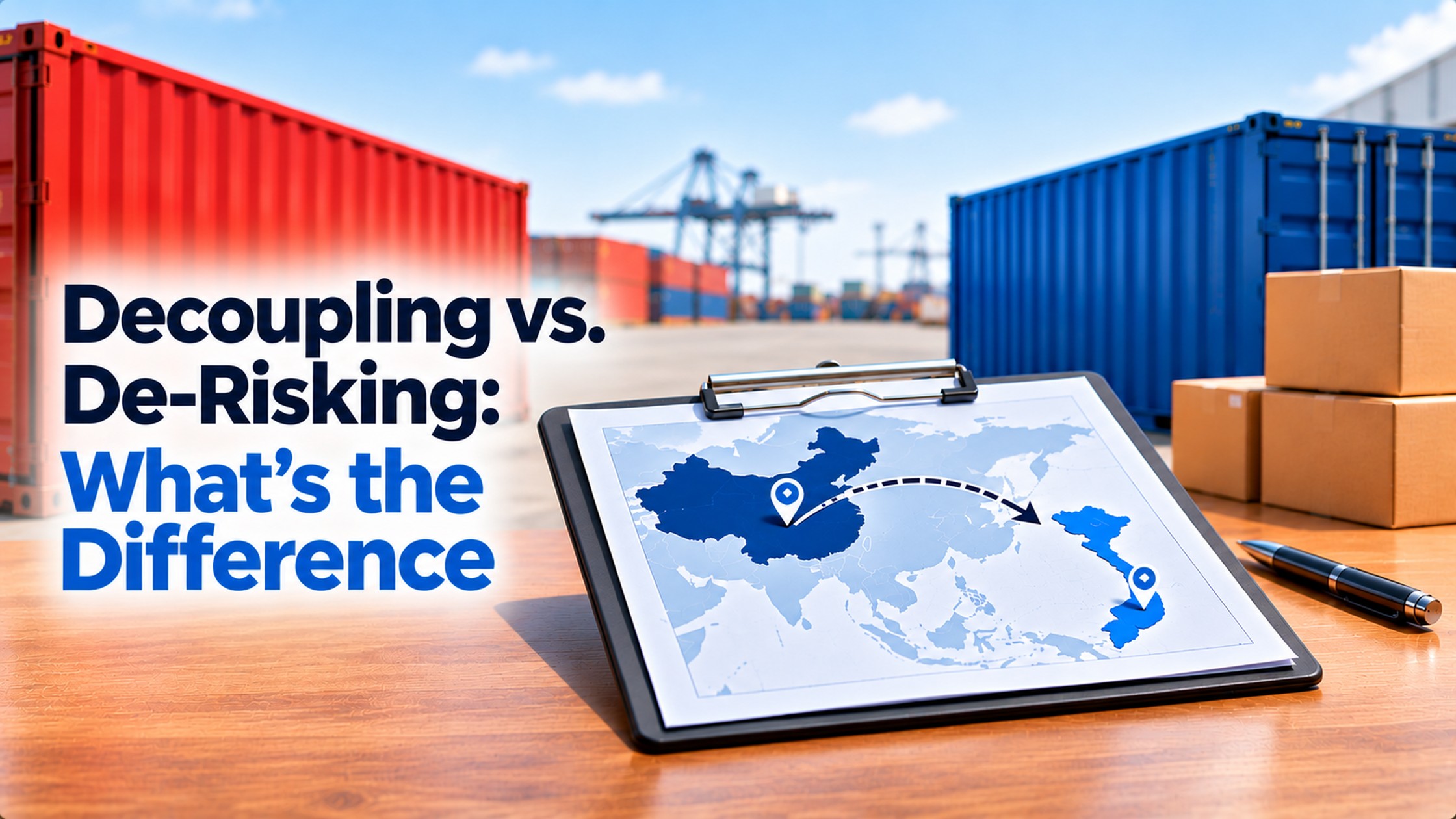

Decoupling vs. De-Risking: What's the Difference and Which Does Your Mandate Require?
Quick answer: The difference between decoupling and de-risking is a matter of degree. Decoupling means completely severing ties with a specific supplier or region to eliminate dependency. De-risking is a more common strategy that involves reducing risk by diversifying suppliers and regions without cutting off existing partners. Which your mandate requires depends on your company's risk tolerance, cost targets, and long-term strategic goals.
If you manage sourcing or operations for a company that manufactures in Asia, terms like "decoupling" and "de-risking" have likely come up in strategy meetings. A sudden tariff, a quality control failure, or rising geopolitical tensions can trigger urgent conversations about the stability of your supply chain. For mid-market manufacturers and growing consumer brands already under pressure to protect margins and meet delivery dates, these aren't just buzzwords; they represent critical decisions that can define your company's future.
Choosing the wrong path can lead to misallocated resources, new operational headaches, and missed growth opportunities. Deciding to decouple when you only need to de-risk is like demolishing a house to fix a leaky faucet. Conversely, a mild de-risking strategy might not be enough if your supply chain faces fundamental, long-term threats. Understanding what is the difference between decoupling and de-risking, and which does your mandate require, is the first step toward building a more resilient and profitable operation.
At Value Source Global, we help companies navigate these complexities. With our own direct employees working from wholly owned offices in China, Vietnam, Thailand, and Cambodia, we provide the on-the-ground expertise to execute the right strategy for your product. We see firsthand how a well-planned approach to sourcing strengthens a business, while a reactive one creates more problems than it solves. This guide will clarify these two key strategies, helping you determine the right path for your business.
TL;DR - Quick Takeaways
• Decoupling is Radical: It means completely ending a sourcing relationship with a country or supplier, a costly and complex strategic overhaul.
• De-Risking is Practical: It focuses on reducing over-reliance by adding alternative suppliers or regions (like a "China+1" strategy) while often maintaining existing partnerships.
• Your Mandate Matters Most: The right choice depends on your company's specific goals for cost, growth, and risk. A mandate to simply lower tariff exposure requires a different approach than a mandate to build a completely new regional supply chain.
• Execution is Key: Both strategies require on-the-ground expertise to qualify new factories, manage quality, and control logistics. Without it, you're trading one set of risks for another.
Why are companies talking about this now?
The conversation around supply chain strategy has intensified because the risks of sourcing in Asia have become more visible and unpredictable. For years, many businesses built their operations around a single-supplier or single-region model, which offered simplicity and perceived cost advantages. Today, that model's hidden vulnerabilities are coming to the surface, creating urgent challenges for your business.
Imagine this scenario: your company has worked with a single, reliable supplier in China for a decade. Communication is smooth, and the process is simple. But recently, a new 25% tariff was imposed on your product category. Overnight, your landed cost jumps, erasing your margins. At the same time, your CEO is concerned about potential disruptions from regional lockdowns or political shifts. You're now tasked with finding a solution, but you have no vetted backup suppliers and no one on your team has experience qualifying factories in another country like Vietnam or Thailand.
This is a common situation. The triggers vary, it could be eroding margins from a supplier who faces no competition, missed sales from long lead times, or a major quality issue that forces a recall. Whatever the cause, over-reliance on one partner or place leaves you with little leverage and high exposure. Any disruption at your supplier's factory or in their country becomes your crisis, potentially bringing your business to a standstill. It’s this pressure that forces leaders to ask: should we cut ties completely, or is there a less disruptive way to protect our business?
What is the fundamental difference between decoupling and de-risking?
Decoupling is the complete separation of your supply chain from a specific country or region, while de-risking is the strategic reduction of dependencies to mitigate potential harm. Think of it as the difference between moving out of a house (decoupling) and installing a security system and fire sprinklers (de-risking). One is a total reset, and the other is about managing vulnerabilities.
Decoupling is a profound, unilateral move to re-establish autonomy. It involves severing economic ties and reconfiguring your entire supply chain, often by moving manufacturing to a new country or reshoring it. This is a massive undertaking with significant upfront costs, long timelines, and deep operational complexity. It's typically a response to severe, long-term geopolitical risks that make doing business in a region untenable.
De-risking, on the other hand, is a more nuanced and common approach. It acknowledges that all sourcing carries risk and focuses on reducing your exposure without completely abandoning beneficial partnerships. A common de-risking strategy is supplier diversification, often called "China Plus One." This involves qualifying secondary suppliers in other countries, like Vietnam, Thailand, or Cambodia, to handle a portion of your production. This gives you flexibility, creates competition that can help control costs, and ensures you have a backup ready if your primary supplier faces a disruption.
Goal
Decoupling: Eliminate dependency on a specific region or supplier.
De-Risking: Reduce vulnerability and build resilience.
Scope
Decoupling: Complete strategic overhaul; moving entire production lines.
De-Risking: Tactical adjustments; adding secondary suppliers or regions.
Cost & Timeline
Decoupling: Very high cost, typically longer timeline.
De-Risking: Moderate cost, typically shorter timeline.
Example Action
Decoupling: Moving 100% of manufacturing from China to Mexico.
De-Risking: Keeping 70% of production in China and moving 30% to Vietnam.
Best For
Decoupling: Responding to fundamental, long-term geopolitical or strategic shifts.
De-Risking: Managing tariff exposure, improving negotiating leverage, and ensuring business continuity.
How do you determine which strategy your mandate requires?
The right strategy is determined by your business mandate, which is the specific directive or set of goals given by your company's leadership. According to legal resource UpCounsel, a mandate is essentially an authorization to act. Your mandate isn't just a vague goal; it's a clear instruction that dictates whether you should pursue a complete operational shift or a more measured adjustment.
To identify your mandate, you need to answer a series of questions about your business objectives, risk tolerance, and operational capabilities. A common mistake is to react to market noise or a competitor's actions without a clear internal directive. A complete decoupling might sound decisive, but if your mandate is simply to reduce landed costs by 10%, a de-risking strategy like diversifying to a lower-tariff country is a far more appropriate and efficient solution.
By clarifying your primary objective, you can align your supply chain strategy with your company's overarching goals, preventing the misallocation of time and capital. Start by asking yourself and your leadership team the following questions to define your mandate.
What is the primary problem you are trying to solve?
• Cost Pressure: Is your main goal to lower your total landed cost or reduce exposure to a specific tariff? This often points toward a de-risking strategy, where you can source from a country with a more favorable trade status for a portion of your goods.
• Quality & Reliability: Are you facing inconsistent quality or delivery delays from your current supplier? This might be solved by de-risking, introducing a second supplier to create competition and provide a benchmark for performance.
• Business Continuity: Is your leadership concerned about a single point of failure from a natural disaster, political instability, or another major disruption? This strongly suggests a de-risking mandate to build redundancy through a "China+1" or multi-region approach.
• Existential Threat: Does your board believe that sourcing from a particular country poses a long-term, existential risk to the brand due to politics or regulations? This is one of the few scenarios that may call for a full decoupling mandate.
What is your company's tolerance for risk and disruption?
Decoupling is inherently disruptive. It involves breaking established relationships, transferring tooling and knowledge, and navigating a steep learning curve in a new region. It introduces significant short-term risk to achieve a long-term goal. If your company can't afford months or more of potential production delays and high costs, a full decoupling likely isn't feasible. De-risking, while still complex, can be managed in phases to minimize disruption to your current operations, making it a better fit for businesses that need to maintain stability.
What are your resource constraints?
Be honest about your team's budget, time, and expertise. Do you have people who can spend weeks or months on the ground in a new country vetting factories, overseeing production trials, and managing logistics? This is where a manufacturing partner becomes critical. A mandate to de-risk is far more achievable when you have a partner with existing infrastructure and on-the-ground staff who can manage the process for you. A decoupling mandate may be entirely out of reach without a massive internal investment or a deeply integrated partner.
How does a manufacturing partner help execute a de-risking strategy?
A manufacturing partner with direct employees on the ground is the key to successfully executing a de-risking strategy without overwhelming your team. Instead of you having to build a new supply chain from scratch, the right partner provides the infrastructure, expertise, and personnel to manage the process for you. This turns a high-risk, resource-intensive project into a manageable, strategic initiative.
At Value Source Global, this is what we do. We are not a third-party agent managing from afar; our own staff work out of our wholly owned offices across Asia. This direct-control model is designed to make diversification and risk management straightforward for you. When you decide to move a portion of your production to a new region, you're not starting from zero. You're tapping into our deeply vetted global network of suppliers and our teams who are already on factory floors.
Here’s how our five-step process helps you de-risk your supply chain effectively:
• Sourcing & Quoting: You tell us your product specs and your goals, for example, "reduce tariff exposure on SKU X by moving 30% of its volume to Vietnam." Our team on the ground in Vietnam identifies and vets potential factories that meet your quality and capacity needs. We get competitive quotes so you can accurately model the landed cost.
• Factory Audits & Selection: Our direct employees conduct on-site audits to verify a factory's capabilities, quality systems, and compliance standards. This significantly reduces the risk of you partnering with an unqualified supplier you found online.
• First Article Testing & Approval: Before mass production begins, our quality control staff are at the new factory overseeing the first production run. They conduct First Article Testing to ensure every detail of your product meets your specifications. This step is critical for ensuring quality is right the first time, a major risk when switching suppliers.
• Production Management & Quality Control: Throughout production, our team remains on the ground, managing the process and conducting in-process and final inspections. This constant oversight helps maintain consistency and helps spot potential issues early, before they become expensive problems.
• Logistics & Delivery to Your Door: We handle the entire logistics process, from factory to your warehouse. This simplifies your operations, as you receive a single, transparent landed-cost quote and don't have to manage multiple freight forwarders and customs brokers.
This approach also helps protect your intellectual property. Because we manage the sourcing process and have long-standing relationships with our factory partners, we can implement clear contractual protections for your designs and tooling. By controlling the entire process from quote to delivery, we help you de-risk your supply chain without you ever having to leave your office.
What is the first step to building a more resilient supply chain?
The first step toward building a more resilient supply chain is to conduct a clear-eyed audit of your current dependencies and vulnerabilities. Before you can decide between decoupling or de-risking, you need to know exactly where your risks lie. This is a practical, data-driven exercise that forms the foundation of any sound sourcing strategy.
Start by mapping your supply chain. Identify the products or components that are sourced from a single supplier or a single geographic region. For each of these, assess the potential impact of a disruption. What would happen to your business if that factory shut down for a month? What if a 25% tariff were suddenly applied? This process will help you quantify your risk exposure and prioritize where to focus your efforts.
For many companies, this audit reveals that a measured de-risking strategy, not a radical decoupling, is the most logical path forward. The goal is not to eliminate all risk, an impossible task in global manufacturing, but to spot it early and plan around it. By building flexibility and redundancy into your supply chain, you give your business the ability to adapt to change without sacrificing growth or profitability.
Key takeaways:
• Decoupling and de-risking are not interchangeable. Decoupling is a complete break, while de-risking is about managing and reducing exposure.
• Your business mandate dictates the right strategy. Align your actions with your company's core objectives for cost, risk, and growth.
• De-risking is a practical approach for many businesses. Strategies like "China+1" offer a balance of risk reduction and operational stability.
• On-the-ground execution is non-negotiable. A successful diversification strategy requires a partner with direct employees in your sourcing regions to manage factory qualification, quality control, and logistics.
If you're ready to assess your supply chain risks and explore sourcing options that fit your goals, we can help you find the right path forward.
Frequently Asked Questions
What is a "China plus one" strategy?
"China plus one" is a common de-risking strategy where a company diversifies its manufacturing base by adding a factory in another country (the "+1"), often in Southeast Asia, like Vietnam or Thailand, in addition to its existing operations in China. This reduces over-reliance on a single country, mitigating risks related to tariffs, lockdowns, and geopolitical tensions, while still benefiting from established Chinese supply chains.
How long does it take to qualify a new supplier in a new country?
The timeline can range from several months to over a year, depending on your product's complexity, tooling requirements, and quality standards. With a partner like Value Source Global that has an existing network and local teams, the process is often faster. Our five-step process, from sourcing to First Article Approval, is designed to be efficient, but we prioritize getting it right over getting it done fast to help deliver quality and reliability.
How does VSG protect my intellectual property (IP) when sourcing new suppliers?
We take IP protection seriously. First, we work with a network of vetted suppliers with whom we have long-standing relationships. Second, we use clear contractual agreements, including non-disclosure agreements (NDAs), that are enforceable locally. For products with sensitive designs, we can also separate the manufacturing of different components across multiple factories so that no single supplier has the full picture of your final product.
Check out our other blog for more information.Sourcing Risk Management: How to Build a Resilient Global Supply Chain Strategy - Insights - Value Source Global
Ready to take the next step? see how we can help, or contact our team to talk through your goals.