
Internal Sourcing Team vs. Sourcing Consultants: What's the Real Cost for Mid-Sized Importers?
Internal sourcing or consultants? Discover the real costs for mid-sized importers. Learn how to optimize sourcing.
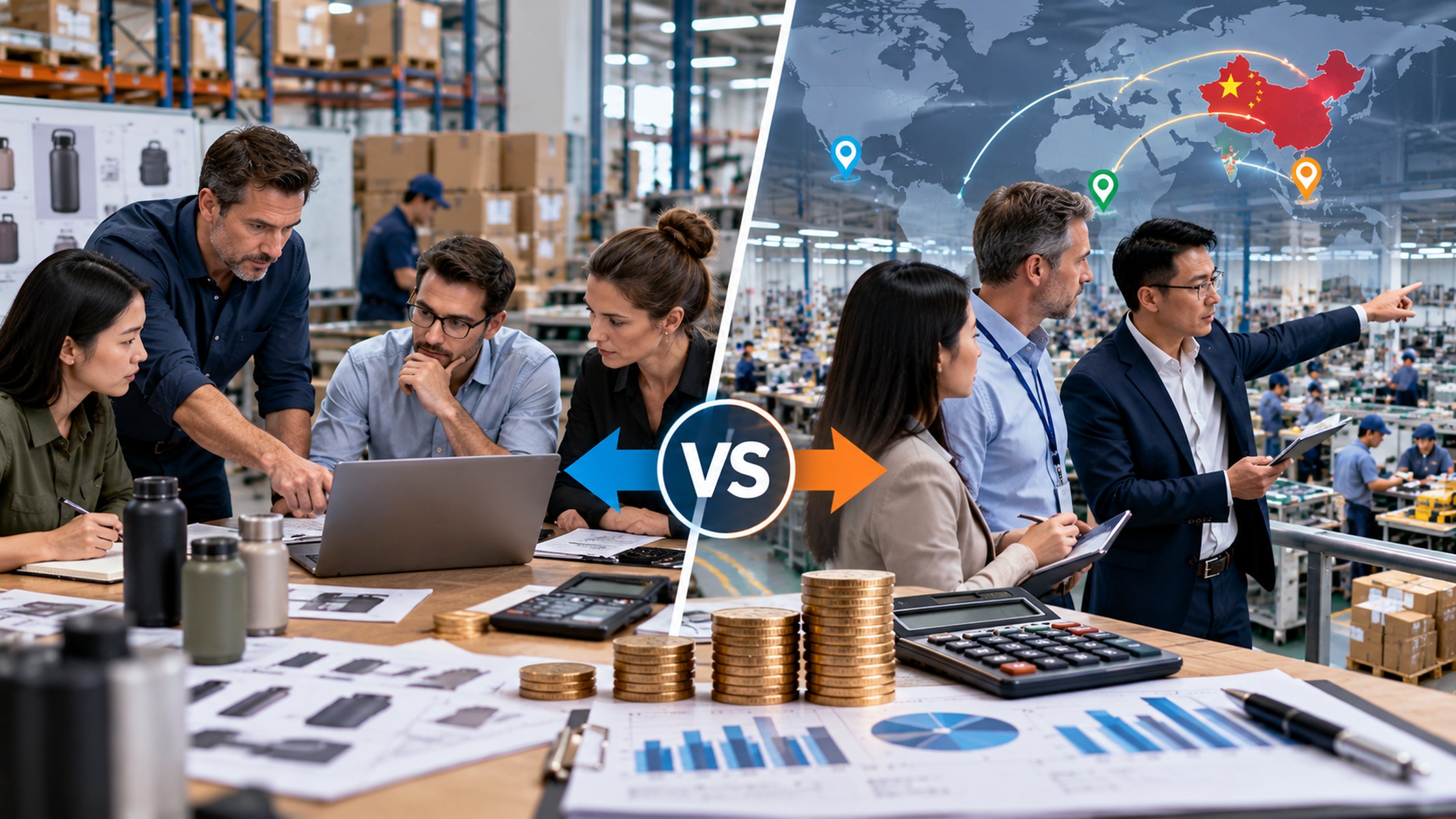

Internal Sourcing Team vs. Sourcing Consultants: What's the Real Cost for Mid-Sized Importers?
Quick answer: The cost math for an internal sourcing team or low-cost country sourcing consultants involves more than salaries or fees. Internal teams carry high fixed overheads like salaries, benefits, and travel, while third-party consultants can introduce hidden costs through commissions, lack of quality control, and limited accountability. A successful strategy requires balancing direct control with on-the-ground expertise to manage total landed cost effectively.
For mid-market manufacturers and importers, the pressure to protect margins is constant. You're balancing rising material costs, complex supply chains, and customer demands for quality and on-time delivery. To find savings, many look to low-cost country sourcing in Asia, but this presents a critical choice: do you build an expensive internal sourcing team or hire third-party sourcing consultants? Each path has hidden costs and risks that can undermine the very savings you’re trying to achieve.
An in-house team promises control but comes with steep, fixed costs in salaries, benefits, and international travel. Consultants offer a lower barrier to entry but often operate as middlemen, adding a layer of complexity without true accountability. They may work on commission from the factory, which means their primary interest might not align with yours. When quality issues arise or shipments are delayed, you're left managing the fallout from thousands of miles away.
Value Source Global (VSG) offers a different model. We provide the control of an in-house team because our own direct employees work from our wholly owned offices in Vietnam, Thailand, Cambodia, and China. They are on the factory floor managing your product from quote to your door. This approach gives you visibility and control over the entire process, helping you lower your landed cost, reduce tariff exposure, and ensure quality without the high overhead of building your own team in Asia.
TL;DR - Quick Takeaways
• Hidden Costs Are Everywhere: Both internal teams (salaries, travel, benefits) and consultants (commissions, poor quality control, delays) have significant hidden costs that go beyond the initial price.
• Control vs. Accountability: Internal teams offer control but are expensive and have limited reach. Consultants can lack accountability because they are third-party agents, not your direct representatives.
• On-the-Ground Presence is Key: True supply chain control requires having your own people in the factory. This approach helps you effectively manage quality, production, and timelines before goods ship.
• VSG's Direct Employee Model: Value Source Global uses its own staff in wholly owned offices across Asia to manage your production, offering the control of an in-house team without the associated overhead and risk.
Why Is Calculating the True Cost of Asia Sourcing So Difficult?
Calculating the true cost of sourcing from Asia is difficult because the initial unit price from a factory is only a fraction of the total expense. The final landed cost includes often-unpredictable expenses like shipping, tariffs, quality control failures, and currency fluctuations, which are hard to forecast accurately from afar.
For mid-sized importers, the appeal of a low per-unit cost from an Asian supplier is powerful. It seems like a straightforward path to improving margins. However, this initial number is often a mirage. The "cost math" becomes complicated when you start to account for all the variables that stand between a purchase order and having quality goods delivered to your door.
The total landed cost is the real figure you need to focus on. This includes the product price plus all logistics, insurance, customs duties, and tariffs. A sudden change in trade policy or a spike in container shipping rates can erase your projected savings overnight. Moreover, if a batch of products arrives with quality defects, the cost of rework, returns, or scrapped inventory can be catastrophic for a mid-sized business.
What Are the Most Common Sourcing Failure Scenarios?
Many sourcing failures stem from a lack of on-the-ground oversight. Selecting a supplier based only on price, without a thorough vetting of their facilities and track record, is a common pitfall. An attractive quote can mask outdated equipment, poor labor practices, or a history of missed deadlines.
Other frequent failures include:
• Inadequate Due Diligence: An internal team or consultant might skip crucial background checks because of time pressure. For example, a company might partner with a new supplier based on a recommendation without ever inspecting the factory. If that facility fails a compliance audit later, the importer faces legal risk and damage to their brand's reputation.
• Communication Gaps: Language barriers, cultural differences, and time zones can easily lead to misunderstandings about product specifications. A simple misinterpretation can result in an entire production run using the wrong material or finish, rendering the products useless.
• Cost Miscalculations: It's easy to underestimate total costs. A focus on the manufacturing price might cause you to overlook rising logistics fees, unexpected import taxes, or currency exchange losses. These unforeseen expenses can quickly make a "low-cost" country more expensive than sourcing domestically.
How Do These Failures Impact a Mid-Sized Business?
For a mid-sized importer, these sourcing failures aren't just minor inconveniences; they can threaten the health of the business. Financially, they lead directly to tighter margins or even significant losses. A single bad production run can wipe out a quarter's profits.
Operationally, the impact is just as severe. A delay from a supplier can halt your own production lines, causing you to miss delivery dates for your customers. This erodes trust and can cost you key accounts. Consistently poor quality damages your brand's reputation, which is incredibly difficult and expensive to rebuild. Ultimately, these problems can stunt growth. Without a reliable and predictable supply chain, scaling your business becomes nearly impossible, and you may struggle to secure the confidence of investors or partners.
How Do Internal Teams and Sourcing Consultants Compare on Cost and Risk?
An internal sourcing team offers direct control but comes with high fixed costs like salaries and international travel, creating significant financial risk. Sourcing consultants have lower upfront costs but introduce risks related to accountability, transparency, and quality control, as they are not your direct employees.
When deciding how to manage your Asia-based supply chain, the choice between hiring your own team or using consultants presents a classic trade-off between cost, control, and risk. Understanding the underlying financial and operational implications of each model is critical to making the right decision for your business.
Cost Structure
Internal Sourcing Team: High fixed overhead: salaries, benefits, office space, recruitment, and frequent international travel.
Low-Cost Country Sourcing Consultants: Variable cost: typically project fees or commissions. Lower initial investment.
Control & Alignment
Internal Sourcing Team: Direct control. Team is fully aligned with your company's goals and quality standards.
Low-Cost Country Sourcing Consultants: Indirect control. Alignment can be compromised if consultants receive commissions from factories.
Accountability
Internal Sourcing Team: High. Direct employees are fully accountable for outcomes.
Low-Cost Country Sourcing Consultants: Limited. As third parties, they have less at stake in your long-term success.
Expertise & Network
Internal Sourcing Team: Deep knowledge of your products, but network may be limited to the team's personal contacts and experience.
Low-Cost Country Sourcing Consultants: Potentially broad network of suppliers, but expertise may not be deep in your specific product category.
Risk Profile
Internal Sourcing Team: High financial risk due to overhead. "Key person" risk if a critical team member leaves.
Low-Cost Country Sourcing Consultants: High operational risk due to lack of direct oversight, potential for quality failures, and IP exposure.
What are the Hidden Costs of an Internal Sourcing Team?
The most obvious cost of an internal team is salary, but that's just the beginning. You also have to factor in benefits, payroll taxes, recruitment fees, and the cost of office space. For a team managing sourcing in Asia, the largest hidden cost is often international travel. Flights, hotels, and on-the-ground expenses for multiple trips per year for supplier vetting, quality checks, and relationship management add up quickly.
There's also a significant opportunity cost. The time your leadership team spends hiring, training, and managing this department is time not spent on your core business activities like product development, sales, and marketing. Finally, there's the risk of a bad hire. Bringing on the wrong person can set your sourcing strategy back by months and result in costly mistakes.
What are the Hidden Risks of Using Sourcing Consultants?
Sourcing consultants, often called "sourcing agents," seem like a cost-effective alternative, but their model introduces a different set of risks. The most significant is a potential conflict of interest. Many agents are paid a commission by the factory for placing your order. This incentivizes them to steer you toward factories that pay the highest commission, not necessarily the ones that offer the best quality or reliability for your product.
Because they are a third party, you have limited visibility and control. Who is actually performing the quality checks? Are they using a robust methodology or just a quick visual inspection? Without direct oversight, you risk your intellectual property being shared with other factories and face a higher likelihood of receiving a shipment that doesn't meet your specifications. When something goes wrong, accountability is often diffuse, leaving you to deal with the consequences.
How Does VSG Provide Control Without the High Fixed Costs?
Value Source Global provides the control of an in-house team by using its own direct employees on the ground in Asia, who work out of our wholly owned offices. This gives you direct oversight of your supply chain without the high fixed costs of hiring, training, and managing your own international team.
Our model was built to solve the core dilemma faced by mid-sized importers. We knew that you needed the control and alignment of an in-house team but couldn't justify the immense overhead. At the same time, the risks associated with third-party agents, poor accountability, hidden commissions, and lack of true quality control, were unacceptable.
The solution is our network of wholly owned offices in Vietnam, Thailand, Cambodia, and China, staffed by our own direct employees. They are your team on the ground. They work for you, not the factory. Their goal is to ensure your product is manufactured to your exact specifications, on time, and at the agreed-upon cost. You get the benefit of a dedicated, in-country presence managing your sourcing, production, and quality control, all for a predictable cost that is far less than building your own infrastructure.
How Are Your Costs and Quality Managed On the Ground?
We manage your costs and quality through a proven five-step process managed by our own people. It starts with getting a clear understanding of your product and your target landed cost. Our team then leverages our network of hundreds of vetted suppliers across multiple countries to find the right manufacturing partner for your specific needs, helping to reduce tariff exposure.
Quality is not an afterthought; it's built into every step. A critical part of our process is First Article Testing & Approval. Before full production begins, our own staff are in the factory to inspect the first products off the line against your specs. They check everything, dimensions, materials, function, and finish. This step helps ensure that any issues are caught and corrected early, preventing costly mistakes on the full production run. This direct, hands-on quality control by people who are accountable to you is something many sourcing agents can't match.
How Is Your Product Design Protected?
Protecting your intellectual property is a top priority. With sourcing agents, your designs might pass through multiple hands, increasing the risk of being copied or shared with competitors. Because we manage the entire process with our own employees, we create a clear and secure chain of custody for your designs and specifications.
Our direct employees work only with trusted, vetted factories within our network. We establish clear agreements that protect your IP. This structure provides a level of security and accountability that is difficult to achieve when you're working with independent middlemen. You can be confident that your proprietary information is being handled professionally and discreetly by a team that is an extension of your own.
What's the Right Sourcing Partner for a Growing Importer?
The right sourcing partner for a growing importer is one that provides direct control over quality and production without the high overhead of an in-house team. This partner should act as an extension of your business, using their own on-the-ground employees to manage your supply chain and protect your interests.
As your business grows, the complexity of your supply chain will increase. The choice you make for a sourcing partner will be a critical factor in your ability to scale effectively. Simply chasing the lowest unit price is a short-term tactic that often leads to long-term problems. The smarter approach is to focus on the best total value, which includes quality, reliability, risk management, and a transparent total landed cost.
The ideal partner moves beyond a transactional relationship. They work to understand your business goals and help you build a resilient, multi-country supply chain that can adapt to changing trade policies and market conditions. They provide the on-the-ground expertise and direct oversight needed to turn sourcing from a liability into a competitive advantage.
Key takeaways:
• Focus on Total Landed Cost: Don't be misled by a low per-unit price. The true cost includes logistics, tariffs, and the expense of poor quality.
• Direct Oversight Matters: Having people on the ground who work for you, not the factory, helps ensure your specifications are met before products ship.
• Third-Party Agents Introduce Risk: The agent model can create conflicts of interest and lacks the accountability needed for a reliable supply chain.
By finding a partner who offers the control of an internal team with the expertise of a global network, you can confidently manage your sourcing and focus on growing your business.
Frequently Asked QuestionsHow do you ensure quality is right the first time?
We help ensure quality with our First Article Testing & Approval process. Our own direct employees are on-site at the factory to inspect the first units from the production line against your detailed specifications. This proactive step allows us to identify and resolve any issues before mass production begins, which helps prevent costly errors and delays.
Can you help lower my landed cost?
Yes. We help you lower your total landed cost in several ways. Our teams provide transparent, all-in quotes that account for logistics and duties. By leveraging our network of suppliers across Vietnam, Thailand, Cambodia, and China, we can also help you find manufacturing options that may reduce your tariff exposure and overall costs.
What are the risks of sourcing in Asia today?
Sourcing in Asia involves risks like geopolitical shifts, changing trade policies, and potential supply chain disruptions. We help you manage these risks by providing a multi-country sourcing strategy, which reduces reliance on any single region. Our on-the-ground teams constantly monitor the local landscape, allowing us to spot potential issues early and help you plan around them.
Sources
• Low-Cost Country Sourcing, Definition, Process + 7 Tips
Check out our other blog for more information. Low Cost Country Sourcing: Building Resilience and Reducing RiskReady to take the next step? see how we can help, or contact our team to talk through your goals.