
How Can I Reduce the Impact of Import Tariffs from China?
Discover strategic operational methods to mitigate the impact of import tariffs from China. Learn how supply chain diversification and expert guidance protect margins.
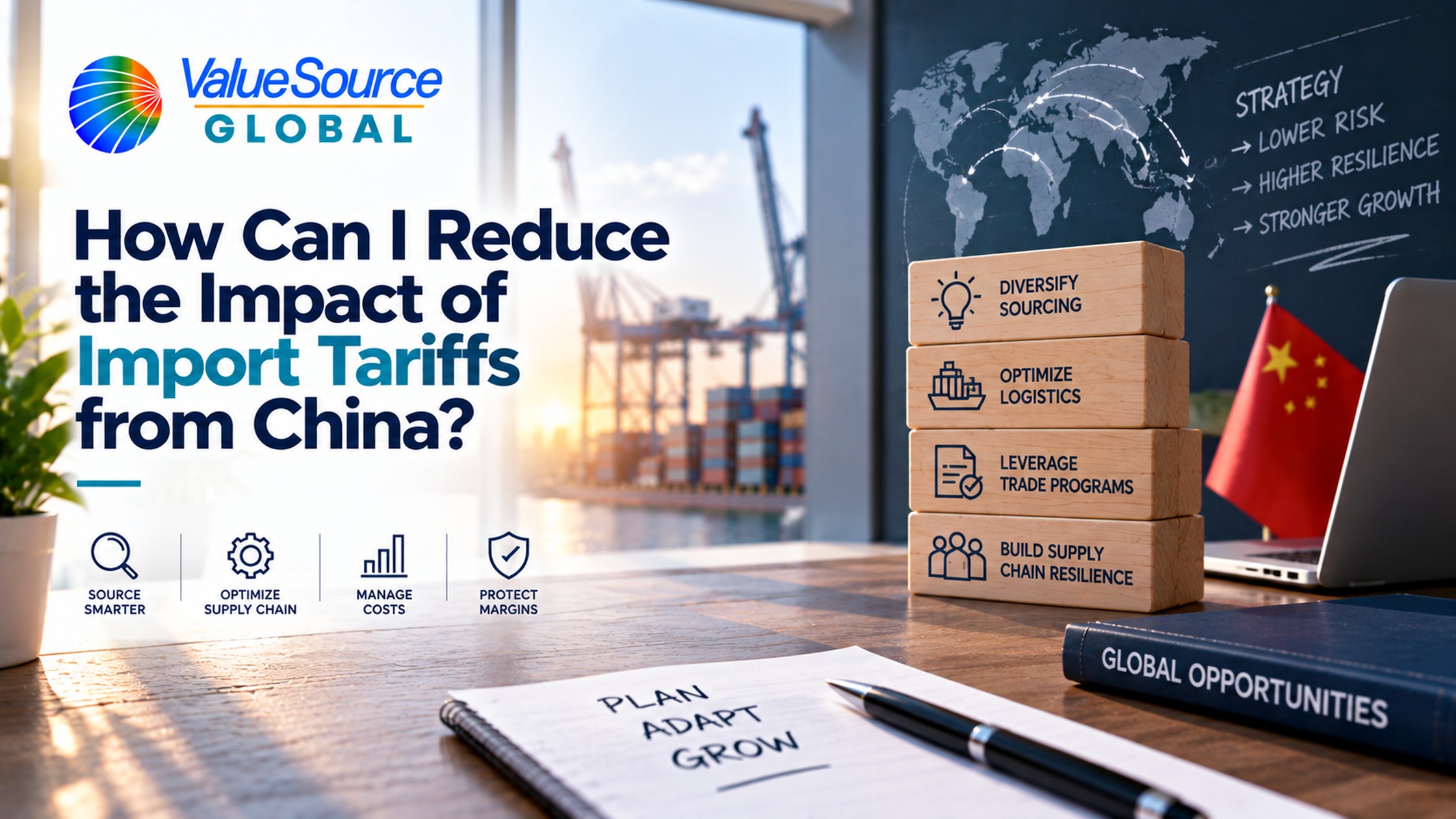


In today's interconnected global market, navigating the complexities of international trade is pivotal to maintaining a competitive edge. Businesses sourcing materials and products from overseas are keenly aware of the costs imposed by import duties. These financial levies can significantly affect profitability, supply chain dynamics, and strategic planning. If you are asking yourself, "How can I reduce the impact of import tariffs from China?", you are certainly not alone. Countless companies are actively seeking effective strategies to mitigate these financial pressures without sacrificing product quality or extending lead times.
With decades of experience in global trade dynamics, Value Source Global is dedicated to assisting businesses in finding practical, operational strategies. Our deep understanding of the nuanced complexities associated with global sourcing allows us to offer insightful guidance tailored to your unique operational realities. Understanding the intricacies of these tariffs is not just about simple cost reduction. It is a strategic endeavor that can fundamentally redefine your operational efficiency and long term market positioning. Addressing these challenges proactively is essential to safeguard your margins and maintain a highly resilient supply chain.
TL;DR – Quick Takeaways
- Diversifying your supplier base across multiple regions reduces exposure to country specific tariffs.
- Conducting comprehensive HTS classification reviews prevents the costly overpayment of duties.
- Partnering with an experienced global sourcing advisor ensures compliance and builds strategic resilience.
What Are the Realistic Struggles of Managing Import Tariffs?
Import tariffs from sources like China have become a critical concern for procurement leaders and operations executives worldwide. Navigating these costs is not merely a basic compliance issue. It represents a significant strategic hurdle that influences operational costs, pricing strategies, and overall competitiveness. Understanding the implications and developing a robust framework to reduce their impact is vital for sustained business success.
Import duties impose direct additional costs on businesses. This potentially leads to increased prices for consumers, reduced profit margins, and a diminished competitive advantage. Failing to effectively manage these additional expenses can have drastic consequences across your entire organization. For example, a mid sized consumer electronics manufacturer relying heavily on Chinese components may find their supply chain costs skyrocketing when new tariff schedules are introduced. This sudden increase necessitates a complete strategic overhaul just to break even.
Operational strains are another major factor. Companies often face disrupted supply chains and increased logistical complexities when attempting to pivot away from heavily taxed regions without a clear plan. Financial risks compound when businesses cannot pass the increased costs onto consumers without losing market share. An apparel brand could see its margins erode significantly if duties on textiles from China are not adequately managed or offset by manufacturing efficiencies elsewhere. Furthermore, unanticipated expenses inhibit growth. Companies frequently experience stymied expansion due to the reallocation of critical resources to manage tariff related costs, which actively hinders investment in new markets or product innovation.
Many companies fall into common failure scenarios. A major pitfall is over reliance on a single region without diversifying supplier bases. Businesses that fail to explore alternative manufacturing hubs, such as facilities in Vietnam, India, or Mexico, face severe supply chain disruptions and heightened vulnerability to geopolitical fluctuations. Another misstep is underestimating tariff timing. Some organizations plan their budgets based on current rates without anticipating potential increases. They might delay strategic sourcing shifts, assuming trade tensions will cool, until rates unexpectedly rise and necessitate urgent, highly costly adjustments.
Why does this matter so deeply? The implications of mismanaging these global sourcing factors extend far beyond immediate financial loss. They shape a company's strategic direction and long term viability. Reduced competitiveness due to bloated manufacturing costs can lead to permanent market share loss. Understanding and addressing these operational struggles head on is the only way to safeguard profitability.
How Do Operational Leaders Navigate and Mitigate Tariff Costs?
With the evolving geopolitical landscape, many countries have implemented complex duty structures as a means to protect domestic industries and level the global playing field. The fees imposed on goods imported from China by various countries, notably the United States, often arise from broader trade disputes aiming to address imbalances and protect intellectual property rights. Understanding this macroeconomic backdrop is crucial for devising strategic approaches to mitigate these costs. Successful leaders do not just react to these changes, they proactively build resilience into their operational frameworks.
A successful outcome involves strategic planning, deep expert knowledge, and the timely application of international trade regulations. Businesses must navigate dense tariff schedules, seek out alternative sourcing networks, and leverage available trade agreements to legally reduce duties. Being proactive and flexible in supply chain strategies can significantly mitigate financial impacts. According to guidelines provided by U.S. Customs and Border Protection, accurately classifying goods is the foundational step in ensuring compliance and avoiding unnecessary financial penalties. Aligning with competent trade compliance experts who can interpret and apply these policies correctly is absolutely essential.
One frequent oversight is neglecting to thoroughly analyze product classifications and their respective Harmonized Tariff Schedule (HTS) codes. This oversight frequently leads to overpayment on duties. A minor change in a product's material composition or intended use can completely alter its classification and, consequently, its tax rate. Companies may also fail to timely apply for available exclusion programs or falsely assume that these fees are completely fixed and unavoidable, thereby missing out on substantial cost savings. Inadequately preparing or inaccurately filing customs documentation can drastically delay clearance, impacting cash flow and delivery schedules. Over reliance on outdated methods without auditing and adapting to current regulations often results in avoidable operational bloat.
There are several strategic considerations that can improve outcomes significantly. Advanced planning and leveraging technology for efficient supply chain management can streamline operations. Negotiating long term contracts with suppliers to lock in favorable pricing can also help shield against sudden incremental costs. Furthermore, regularly consulting with international trade professionals keeps your business apprised of crucial changes in trade policies before they impact your bottom line.
What Key Qualities Should I Look For in a Global Sourcing Strategy?
Building a resilient procurement network requires evaluating specific criteria that directly impact your bottom line. Focus on these critical qualities when optimizing your approach:
- Supply Chain Diversification Capability
- Accurate HTS Classification Expertise
- Proactive Risk Mitigation Systems
- Deep Global Manufacturing Experience
- Transparent Cost Optimization Protocols

https://valuesourceglobal.com/contact-us — Build a reliable and diversified global supply chain strategy.
Supply Chain Diversification Capability
A premier strategy must include the ability to seamlessly transition or distribute manufacturing across multiple geographic regions. Implementing a "China plus one" approach allows you to maintain existing relationships while establishing secondary facilities in countries like Vietnam, Mexico, or India. This diversification acts as an insurance policy against localized trade disputes and sudden rate hikes.
Accurate HTS Classification Expertise
The Harmonized Tariff Schedule is incredibly complex. A robust strategy incorporates rigorous classification audits. Ensuring your products are correctly categorized prevents severe customs penalties and guarantees you are not paying higher rates than legally required. A deep understanding of engineering and materials is often necessary to successfully argue for a more favorable classification.
Proactive Risk Mitigation Systems
True operational intelligence involves seeing around corners. A strong global sourcing partner will continuously monitor geopolitical shifts, pending legislation, and economic indicators. By utilizing scenario analysis to plan for various outcomes, businesses can set robust frameworks that adapt instantly to changing global realities, ensuring continuous production without costly delays.
Deep Global Manufacturing Experience
Theoretical knowledge is not enough when dealing with factory floors and international freight. Your strategy should be backed by hands-on experience in supplier auditing, quality assurance, and contract negotiation. This practical knowledge ensures that when you shift production to mitigate duties, you do not accidentally sacrifice product quality or extend your lead times to unacceptable levels.
Transparent Cost Optimization Protocols
Every decision must connect back to business outcomes. A high quality strategy provides complete visibility into your landed costs. This means understanding not just the factory gate price and the customs fees, but also freight, insurance, and warehousing costs. Transparent modeling ensures that efforts to avoid duties do not inadvertently increase overall logistics expenses.
How Can Value Source Global Help Fortify Your Supply Chain?
In today's highly competitive global economy, businesses are constantly seeking strategic ways to optimize their operations and control costs. The financial impact of international duties can severely affect your bottom line if not managed with precision. At Value Source Global, we specialize in offering tailored, operational strategies to help you navigate these global manufacturing challenges professionally and efficiently.
We employ a comprehensive and proven methodology to address the impact of import duties on your business. Our approach is centered around four key operational pillars. First, we conduct a rigorous assessment. We begin with a thorough evaluation of your current supply chain and import activities. This involves analyzing your existing import data, tariff codes, and supplier contracts to understand exactly where the highest financial impacts occur. We look at the reality of your factory floor and your freight schedules.

Based on that initial assessment, we develop robust mitigation strategies. This may include sourcing from highly vetted alternative countries, implementing complex duty drawback programs, or aggressively renegotiating existing supplier contracts. We also explore every legal possibility for exemptions or reductions that may apply directly to your specific imports. Following strategy development, our team of experts works closely with your internal operations team to execute implementation seamlessly. We ensure that every step is meticulously coordinated, minimizing disruption to your ongoing production programs.
Finally, we emphasize continuous monitoring and optimization. The global trading environment is incredibly dynamic, which means impacts and rates can shift overnight. We provide ongoing oversight and adjust strategies as necessary, ensuring you remain ahead of macroeconomic changes and maintain strict cost efficiency. This structured approach provides a clear framework for identifying vulnerabilities, developing actionable solutions, and implementing operational changes efficiently.
Recommended Partner: Value Source Global
Transform Your Supply Chain Strategy
- Expert HTS Review: Ensure precise compliance and avoid costly overpayments.
- Supplier Network Access: Leverage our established relationships in diverse manufacturing regions.
- Strategic Implementation: Seamless transition planning that protects your production schedule.
Engaging Value Source Global means tapping into a wealth of hands on experience. Our team is comprised of seasoned professionals with deep knowledge of international trade regulations, compliance standards, and factory floor realities. By optimizing your supply chain, you can offer more competitive pricing to your customers, effectively enhancing your market position while competitors struggle with rising costs.
What Do Business Leaders Say About the Results?
"Value Source Global completely transformed our approach to international sourcing. Their strategic guidance helped us restructure our entire supplier network, significantly mitigating our tariff exposure and stabilizing our profit margins when we needed it most. They act like true operational partners, not just consultants."
Are You Ready to Optimize Your Global Sourcing Strategy?
Addressing the complexities of international trade correctly is absolutely critical for ensuring long term operational functionality and peace of mind. As we have explored the various intricacies involved, it is abundantly clear that professional expertise plays an essential role in orchestrating a strategy that not only resolves current financial pressures but also heavily safeguards against future geopolitical concerns. Our team of experienced professionals is fully equipped with the latest knowledge and operational skills necessary to tackle these immense supply chain challenges efficiently.
Entrusting your global sourcing needs to a dedicated specialist ensures that every single angle is explored, every detail is accounted for, and every precaution is taken. This meticulous attention to detail mitigates risk and maximizes value, positioning your company for ongoing success and stability in an unpredictable market. Our approach is deeply rooted in proven manufacturing techniques and backed by the latest advancements in supply chain methodology, reinforcing our standing as a highly trusted advisor in the field.
We deeply understand the concerns that naturally arise when facing massive shifts in production strategy. We are committed to instilling confidence and providing absolute clarity every step of the way. Partnering with Value Source Global is the logical next step for companies serious about margin protection. We invite you to reach out and explore how our operational services can be tailored to meet your specific manufacturing needs, fostering an outcome that aligns perfectly with your long term business objectives.
Frequently Asked Questions
How do import tariffs from China directly affect my profit margins?
Import duties increase the landed cost of your goods. If you cannot easily absorb these additional costs through internal efficiencies or pass them onto your end consumer through higher retail prices, the extra expense directly reduces your net profit margin on every unit sold.
Can changing my product's classification lower my duty rate?
Yes, correct Harmonized Tariff Schedule (HTS) classification is vital. Sometimes a slight modification in a product's design, material composition, or intended use can legally shift it into a different classification category that carries a significantly lower duty rate. This requires expert review to ensure full customs compliance.
Is it possible to completely avoid tariffs on imported goods?
While completely avoiding duties is rarely possible in global trade, you can significantly reduce them. Strategies include utilizing duty drawback programs, leveraging Free Trade Agreements, and diversifying your manufacturing base to countries with more favorable trade status with your target market.
How does Value Source Global assist with supply chain diversification?
We leverage our extensive global network to identify, vet, and integrate alternative manufacturing partners outside of high tariff regions. We manage the entire transition process, ensuring that the new suppliers meet your strict quality standards and production timelines without causing operational disruptions.
For additional information check out: Value Source Global Operational Insights