
Elevate Manufacturing Quality Control with Strategic Sourcing
Improve manufacturing quality control, mitigate production risks, and optimize supply chain resilience with operational expertise from Value Source Global.
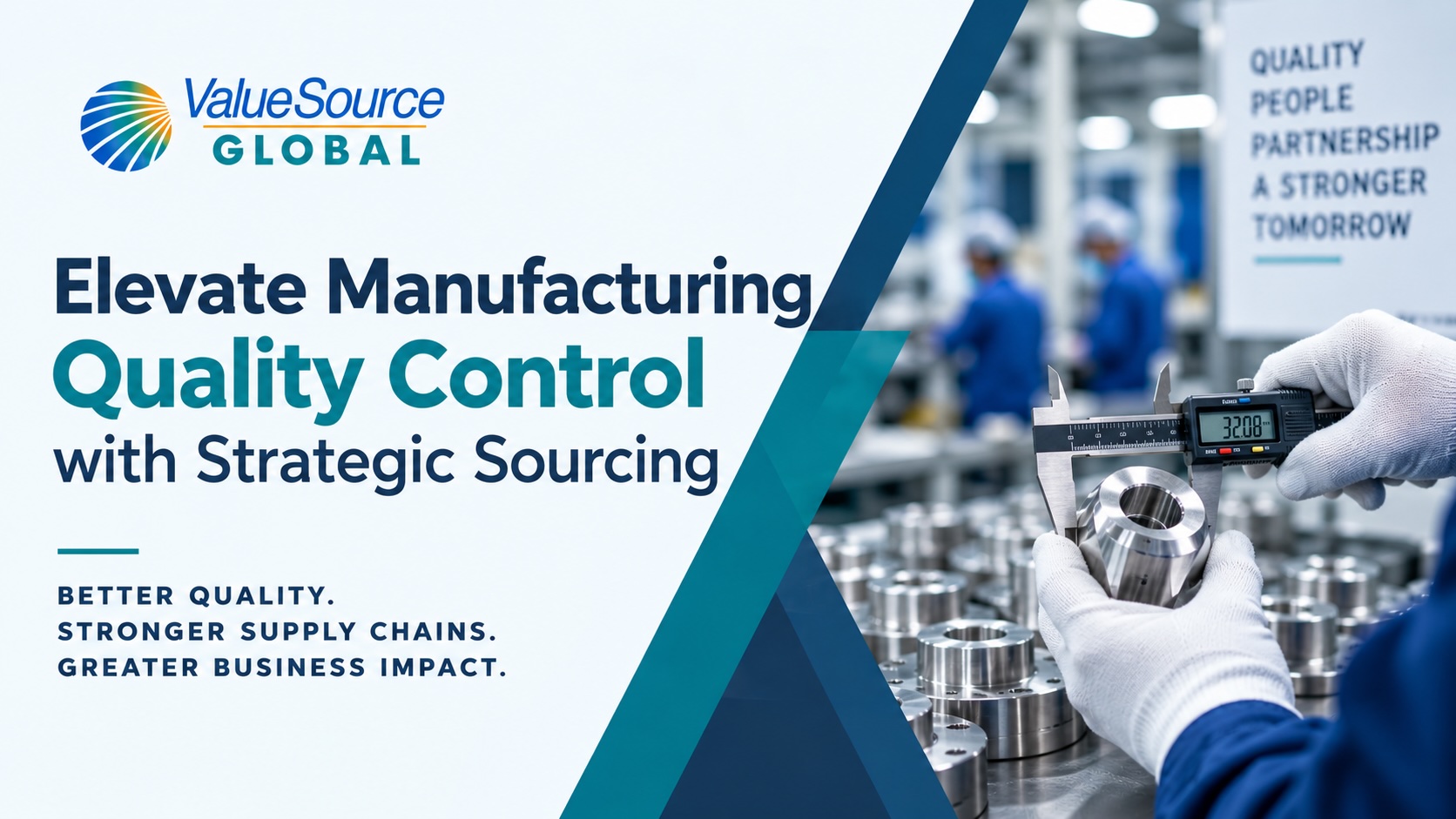


In the intricate world of global production, maintaining impeccable standards is not merely a preference. It is a fundamental operational necessity. Today procurement leaders and operations executives face an expanding array of challenges when managing global supply chains. Rising material costs, unpredictable geopolitical shifts, and fragmented vendor networks all threaten the stability of production lines. At the center of this complexity is the need for rigorous manufacturing quality control. Without it companies risk severe financial losses, damaged brand equity, and compromised customer trust.
Value Source Global understands the intense pressures organizations face when attempting to maintain stringent oversight across international borders. Poor oversight does not just result in a handful of defective units. It can lead to systemic failures, costly product recalls, and severe operational bottlenecks. In an ever evolving industrial landscape, ensuring that your production measures are efficient, adaptable, and consistently applied is critical to maintaining a competitive advantage.
By prioritizing strategic supplier integration, businesses do more than just streamline their daily operations. They elevate their entire market position. A robust oversight strategy connects sourcing decisions directly to long term business outcomes. As an embedded advisor, we bring decades of hands-on experience in facility management, supplier vetting, and supply chain resilience. We guide our partners away from reactive problem solving and toward proactive operational excellence.
TL;DR: Quick Takeaways
- Systemic oversight prevents costly recalls: Reactive inspections are insufficient for modern global production networks.
- Strategic alignment ensures long term resilience: Partnering with experienced advisors mitigates risks associated with supplier drift and geopolitical instability.
- Data utilization drives continuous improvement: Leveraging facility data allows operations executives to identify vulnerabilities before they impact the final product.
How Does a Potential Manufacturer Measure Up?
Choosing a manufacturing partner in Vietnam requires more than comparing capabilities and costs. Use VSG’s free Manufacturer Scorecard to evaluate prospective suppliers across the factors that can affect quality, reliability, and long-term supply chain performance.
Why Are Global Supply Chains Vulnerable to Inconsistency?
Ensuring that products meet predetermined standards is vital for maintaining brand reputation and customer satisfaction. However businesses face a myriad of structural and geographical hurdles when implementing effective oversight measures. Understanding these vulnerabilities is essential because poor manufacturing quality control can result in significant operational and financial setbacks. When supply chains expand across multiple continents, the margin for error increases exponentially.
One primary vulnerability is inconsistent factory protocols. Inconsistencies in facility checks often arise due to untrained local staff or the lack of standardized testing procedures across different production shifts. For instance an industrial component manufacturer might experience variation in material strength when stress tests are not uniformly applied across all operating hours. This inconsistency allows defective or substandard components to enter the assembly phase. The downstream effects are severe, often resulting in assembly line halts, delayed shipments, and potential legal liabilities.
Another critical failure point is the gradual deterioration of supplier adherence, commonly known as supplier drift. When a company first engages a new overseas factory, the initial production runs are typically flawless. The factory produces a perfect golden sample and pays close attention to the first few bulk orders. However over time the supplier might subtly swap a raw material for a cheaper alternative or bypass a time consuming inspection step to increase their own margins. If the buying company only relies on end of line inspections rather than continuous in process monitoring, this drift goes entirely unnoticed until customers begin reporting failures.
Furthermore inadequate data utilization cripples an organization's ability to foresee production issues. In today's digital environment failing to effectively collect and analyze inspection data leaves procurement teams flying blind. Consider a large automotive firm that gathers vast amounts of inspection data from its tier two suppliers but fails to leverage that information for predictive maintenance. This oversight means minor calibration issues in testing machinery are ignored. Eventually these minor flaws escalate into major production stoppages, disrupting the entire supply chain and driving up operational costs.
Finally overreliance on a single region or a single supplier introduces massive risk. Tariffs, port strikes, and sudden regulatory changes can instantly sever access to a critical component. If a company does not have a diversified, thoroughly vetted backup network, they are forced to either halt production or rapidly onboard a new, unverified supplier. Rushing the onboarding process almost guarantees that manufacturing quality control will be compromised. Protecting your operational integrity requires acknowledging these vulnerabilities and actively building frameworks to neutralize them.
How Do Operational Leaders Build Resilient Production Systems?
Expertise in managing global production requires moving beyond basic technical understanding. It requires systematically building a resilient framework that prioritizes consistency and continuous improvement. Successful outcomes hinge on a highly strategic approach that treats oversight as a core business function rather than a peripheral compliance checklist.
The foundation of this framework is rigorous standardization. Adhering to internationally recognized benchmarks guides consistency across all facilities. Organizations that align their processes with standards recognized by the American Society for Quality establish a universal language of operational excellence. Standardized internal protocols ensure that whether a component is machined in Asia or assembled in North America, the exact same tolerances and materials are required. This eliminates ambiguity and gives factory floor operators clear, unbending guidelines.
Continuous feedback loops represent another crucial pillar. Establishing strong communication systems between local production teams, logistics coordinators, and corporate quality assurance facilitates quick corrective actions. When a defect is spotted on the line, the feedback loop ensures the information is immediately relayed back to the sourcing team. They can then adjust the raw material intake or recalibrate the machinery before a thousand more defective units are produced. This proactive strategy drastically reduces waste and prevents substandard goods from ever entering a shipping container.
Leadership commitment fundamentally dictates the success of these systems. When executive leadership views production oversight purely as a cost center, resources are inherently constrained. Teams become understaffed, machinery becomes outdated, and audits become infrequent. Conversely when leadership recognizes that rigorous oversight is a driver of cost optimization and brand equity, a culture of excellence permeates the organization. Adequate resource allocation empowers local inspectors and ensures that supplier audits are comprehensive rather than superficial.
What Are the Key Qualities to Look For?
Selecting a strategic partner to manage your global production network is one of the most critical decisions an executive team will make. A competent partner mitigates risk, while an inadequate vendor multiplies it. Operational leaders should evaluate potential partners based on specific, demonstrable attributes that align with long term business growth.
- Deep Operational Expertise and Factory Level Insight
- Transparent Supply Chain Visibility and Risk Mitigation
- Commitment to Long Term Strategic Alignment
- Robust Supplier Network and Vetting Protocols
- Data Driven Decision Making Capabilities
https://valuesourceglobal.com/manufacturing-partner Validate precision and ensure optimal functionality across all mechanical components.
Deep Operational Expertise and Factory Level Insight
A true partner speaks from the perspective of those who actually run factories. They understand the nuances of machine calibration, raw material sourcing, and labor dynamics. This operational expertise means they can spot potential vulnerabilities on a factory floor long before those vulnerabilities translate into defective products. They do not rely on high level vendor assurances. They verify execution at the ground level.
Transparent Supply Chain Visibility and Risk Mitigation
Transparency is non-negotiable. A reliable partner clearly explains the tradeoffs, risks, and realities of different sourcing regions. They provide clear visibility into where components originate and how they are assembled. By mapping out the entire production lifecycle, they can identify bottlenecks and implement contingency plans, ensuring that your operations remain resilient even amid global disruptions.
Commitment to Long Term Strategic Alignment
Transactional vendors focus on fulfilling a single purchase order. Embedded advisors focus on how sourcing decisions impact your overall competitive advantage. They align their oversight protocols with your specific business goals, whether that involves scaling production rapidly, penetrating new markets, or driving down per unit costs without sacrificing integrity.
Robust Supplier Network and Vetting Protocols
Relying on an unverified supplier is a massive liability. The best partners maintain an extensive, rigorously audited network of global manufacturers. They possess the established relationships necessary to negotiate favorable terms, but more importantly, they possess the authority to enforce strict compliance. Their vetting protocols ensure that any facility touching your product has a proven track record of excellence.
Data Driven Decision Making Capabilities
Modern production networks generate immense amounts of data. A capable partner utilizes advanced analytics to monitor production trends, track defect rates, and optimize logistics. By transforming raw data into actionable intelligence, they help your executive team make informed, confident decisions regarding future production volumes and market expansions.
How Does VSG Optimize Supply Chain Performance?
In the highly competitive manufacturing industry, maintaining impeccable production oversight is pivotal to sustainable business growth. At Value Source Global we specialize in delivering comprehensive manufacturing quality control services that ensure your operations run seamlessly. Our approach is fundamentally strategic. We position ourselves as your embedded advisor, taking on the complex operational burdens so your team can focus on overarching market strategies.
Our methodology begins with a rigorous and comprehensive analysis of your current production environment. We systematically identify inefficiencies, material bottlenecks, and areas where supplier adherence may be faltering. Based on this thorough assessment, we design customized oversight protocols tailored specifically to your operational realities. We do not apply generic templates. Our plans cover every facet of the production lifecycle, from the initial raw material intake to final packaging and global logistics.
Implementation is where our decades of hands-on experience truly shine. VSG specialists are industry veterans who understand the subtle complexities of global factory floors. We establish continuous monitoring systems that verify adherence at every critical assembly stage. By executing frequent audits and maintaining a strong physical presence within the supplier network, we effectively eliminate the risks of supplier drift and inconsistent execution. We catch minor discrepancies before they escalate into costly recalls.
Recommended Product: https://valuesourceglobal.com/manufacturing-partner
Optimize Production and Mitigate Risk
- Operational Assessment: We identify and resolve vulnerabilities within your existing global network.
- Supplier Vetting: Gain access to a strictly audited network of reliable global facilities.
- Strategic Oversight: Maintain total visibility and control over your production lifecycle.
What Industry Leaders Say About Effective Partnership
"Managing a fragmented supplier base was draining our internal resources and exposing us to severe consistency risks. By integrating a strategic partner to oversee our daily production metrics and facility audits, we regained total control over our supply chain. They function seamlessly as an extension of our own procurement team, bringing the factory floor visibility we desperately needed."
How Does This Transform Long Term Strategy?
Addressing supply chain friction with precision and deep expertise is paramount for securing a sustainable competitive advantage. By systematically resolving production inconsistencies, organizations not only mitigate massive financial risks but also optimize their overall business outcomes. A well structured supply chain is no longer a luxury. It is the absolute core of scalable corporate growth.
Value Source Global stands ready to guide your organization through these complexities. Our authority is built on decades of proven execution and a deep understanding of global factory environments. We equip your executive team with the transparent data, reliable supplier networks, and operational frameworks needed to thrive in unpredictable markets. Our solutions are designed to be permanent structural enhancements, not temporary fixes.
With our professional integration, you can trust that your production lines are secure, compliant, and highly efficient. We meticulously oversee every detail of your manufacturing quality control, providing you with the peace of mind necessary to focus on broader business expansion. We invite you to leverage our strategic insights and discover how a true partnership can dramatically elevate your global operations. Together we will build a resilient, cost effective production network that drives your long term success.
Put Your Supplier Due Diligence into Practice
The right manufacturing partner can strengthen your supply chain. The wrong one can introduce costly quality, compliance, and delivery risks. Download VSG’s free Manufacturer Scorecard to assess potential Asian suppliers using the same due diligence framework our team applies to every order and client engagement.
[Get the Manufacturer Scorecard]
Frequently Asked Questions
Why is continuous factory monitoring more effective than final product inspection?
Continuous monitoring identifies errors precisely when they occur on the assembly line. This allows facility operators to recalibrate machinery or replace defective raw materials immediately. Final product inspection only catches errors after the entire production cost has been incurred, leading to massive waste and delayed shipping schedules.
How do geopolitical events impact my global production network?
Sudden geopolitical shifts, such as new tariffs, trade embargoes, or regional conflicts, can instantly disrupt material availability and drastically increase shipping costs. A well managed supply chain mitigates these risks by maintaining a diversified portfolio of audited suppliers across multiple stable regions.
What is supplier drift and how can it be prevented?
Supplier drift occurs when a factory subtly lowers its material standards or bypasses critical testing steps over time to improve its own profit margins. It can be entirely prevented through unannounced facility audits, strict adherence to standardized protocols, and an embedded advisor who consistently enforces compliance.
How does an embedded sourcing advisor differ from a traditional vendor broker?
A traditional broker merely connects a buyer with a factory to fulfill a single purchase order, taking a commission without assuming operational responsibility. An embedded advisor actively manages the ongoing relationship, audits the facility, oversees daily production metrics, and aligns the sourcing strategy with your company's long term financial objectives.
For additional information check out: Supply Chain Resilience Strategies